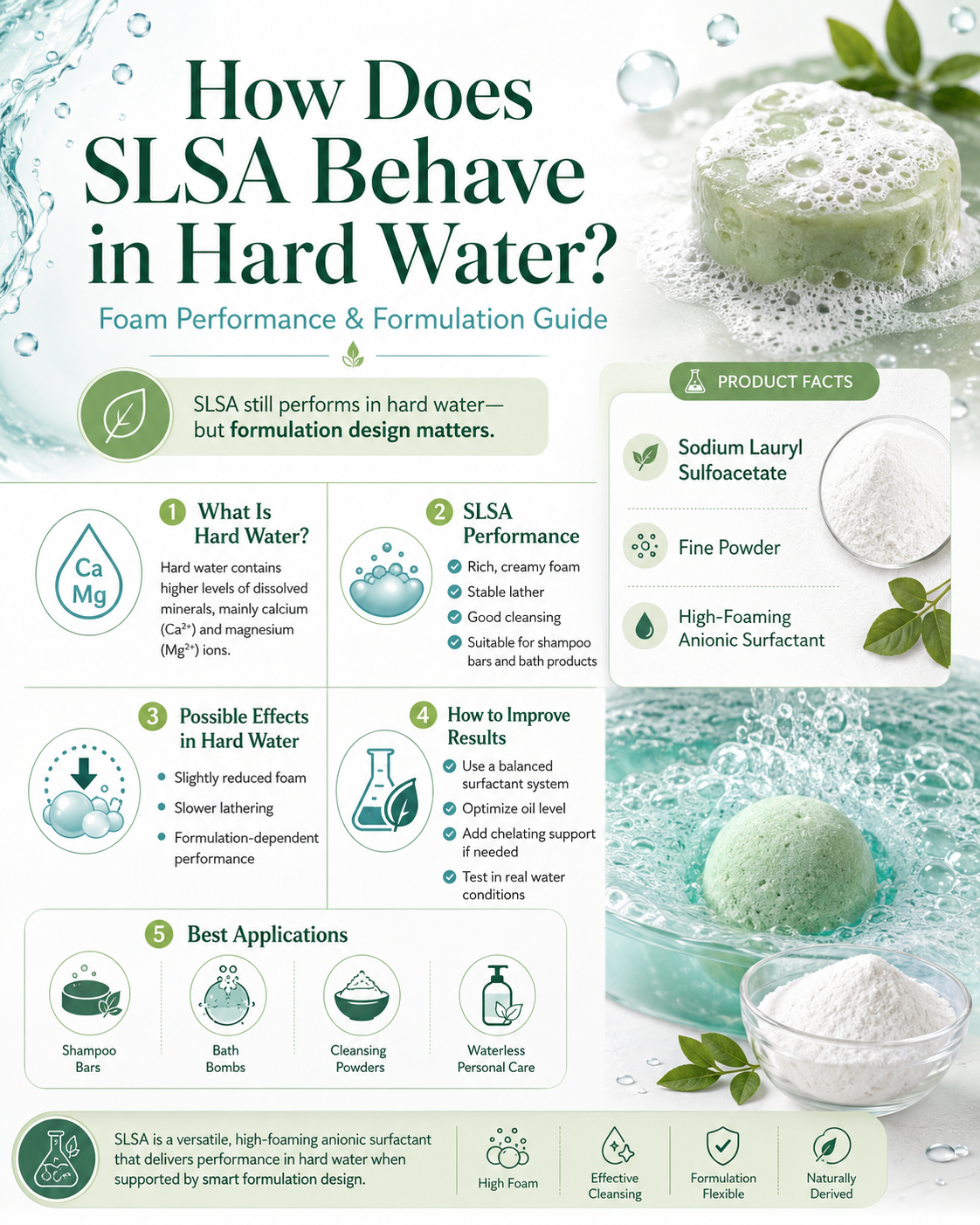
How Does SLSA Behave in Hard Water?
SLSA (Sodium Lauryl Sulfoacetate) is a mild anionic surfactant widely used in shampoo bars, bath bombs, facial cleansers, and cleansing powders.
When used in real-world conditions, one important factor that affects performance is water hardness.
Hard water contains higher levels of minerals such as calcium (Ca²⁺) and magnesium (Mg²⁺), which can interact with surfactants and influence foam and cleansing performance.
What Is Hard Water?
Hard water refers to water that contains elevated levels of dissolved minerals, mainly:
- Calcium ions (Ca²⁺)
- Magnesium ions (Mg²⁺)
These minerals can interact with surfactants and sometimes reduce foam volume or affect cleansing efficiency in personal care products.
Hard water is common in many regions worldwide, especially areas with limestone-rich water sources.
Does SLSA Work in Hard Water?
Yes — SLSA still works in hard water conditions, but its performance may be influenced depending on the full formulation.
In general:
- SLSA can still generate foam in hard water
- Foam may be slightly reduced compared to soft water
- Proper formulation can help stabilize performance
👉 The key point is:
SLSA performance depends more on the full surfactant system than on SLSA alone.
How Hard Water Affects Surfactants
In hard water, calcium and magnesium ions can interact with surfactants and cause:
- Reduced foam volume
- Slower lathering
- Slight cloudiness in solution
- Reduced cleansing efficiency (in some systems)
However, not all surfactants behave the same way.
SLSA Performance in Hard Water
1. Foam Generation
SLSA can still produce visible foam in hard water, although foam volume may be slightly lower compared to soft water conditions.
However, in solid systems like shampoo bars or bath bombs, the difference is often less noticeable to consumers when the formula is well balanced.
2. Foam Stability
SLSA is known for producing creamy and stable foam, which helps maintain a pleasant sensory experience even when water hardness is higher.
This makes it suitable for:
- Shampoo bars
- Bath bombs
- Bubble bath powders
3. Cleansing Performance
SLSA continues to provide cleansing action in hard water, but formulation balance is important to ensure:
- Good rinse-off performance
- No heavy residue
- Comfortable skin feel
4. Sensory Experience
Even in hard water conditions, SLSA-based systems can still deliver:
- Rich foam feel
- Soft lather texture
- Smooth application
- Good product spreadability
Why Shampoo Bars Are Sensitive to Hard Water
Shampoo bars are more sensitive to hard water than liquid shampoos because:
- They rely on surfactant activation during use
- Foam is generated directly on hair
- There is no large dilution phase like liquid shampoo
If the formula is not optimized, users may experience:
- Less foam in hard water
- Longer lather time
- Slight “drag” during washing
How to Improve SLSA Performance in Hard Water
Formulators can improve SLSA performance in hard water by optimizing the overall system.
1. Use a Balanced Surfactant System
SLSA performs better when combined with other surfactants such as:
- SCI (Sodium Cocoyl Isethionate)
- Amphoteric surfactants
- Nonionic surfactants
This helps stabilize foam even in mineral-rich water.
2. Optimize Oil and Butter Content
Too much oil or butter can reduce foam, especially in hard water conditions.
A balanced ratio helps maintain performance.
3. Add Chelating Agents (If Needed)
Chelating agents can help reduce the effect of calcium and magnesium ions.
This can improve:
- Foam consistency
- Cleansing efficiency
- Overall stability
4. Improve Powder Dispersion
SLSA is a fine powder, so even distribution in the formula helps ensure consistent foam performance.
5. Test in Real Water Conditions
Always test shampoo bars or bath products in:
- Soft water
- Hard water
- Different geographic markets
This ensures real-world performance stability.
SLSA vs Other Surfactants in Hard Water
Compared to some traditional surfactants:
- SLSA performs better than many sulfate-free powders in foam stability
- SLSA is more stable in solid systems than many liquid surfactants
- SLSA is less affected when used in properly balanced formulations
Best Applications in Hard Water Regions
SLSA is especially suitable for:
- Shampoo bars in hard water markets
- Bath bombs in spa products
- Cleansing powders for travel use
- Waterless personal care systems
- Solid cosmetic formulations
Key Takeaway
SLSA does work in hard water conditions, but performance depends heavily on formulation design.
👉 In summary:
- Hard water may slightly reduce foam
- SLSA still provides stable cleansing performance
- Proper formulation can minimize performance differences
- Shampoo bars require optimized surfactant systems for best results
Looking for SLSA Powder for Your Formulation?
We supply Sodium Lauryl Sulfoacetate SLSA in fine powder and coarse powder grades for bath bombs, shampoo bars, facial cleansers and mild cleansing formulations.
Request COA / TDS / SDS
Get Factory Price
Ask for Sample
About Our SLSA Supply
We are a professional manufacturer of:
Sodium Lauryl Sulfoacetate (SLSA) Fine Powder
Suitable for:
- Shampoo bars
- Bath bombs
- Facial cleansers
- Cleansing powders
- Solid personal care products
We provide:
- COA / TDS / SDS
- Stable bulk supply
- OEM support
- Sample testing
Contact Us
🌿 Hubei Tanmu Biotech Co., Ltd.
📧 [email protected]
🌐 www.tanmubiotech.com
📞 +86 027-87050107



 Sales Manager
 Sales Manager