Beyond Foam Height: How to Evaluate Sodium Lauryl Sulfoacetate (SLSA) for High-Performance Personal Care Formulations
Sodium Lauryl Sulfoacetate, commonly known as SLSA, has become an important surfactant for bath bombs, shampoo bars, cleansing powders, syndet bars and other solid or low-water personal care products.
For formulators, SLSA offers a useful balance of cleansing, foam generation and formulation flexibility. For purchasing teams, however, selecting the right cosmetic-grade SLSA powder requires more than comparing a product name and price.
Two suppliers may both offer “Sodium Lauryl Sulfoacetate,” yet their materials can behave differently because of variations in:
- Active matter
- Moisture
- Inorganic salt content
- Residual fatty alcohol
- Particle-size distribution
- Powder density
- Odour
- Storage stability
- Manufacturing consistency
Therefore, a reliable SLSA sourcing decision should evaluate chemical quality, foam performance, processing behaviour, documentation and cost per kilogram of active matter.
This guide explains what cosmetic manufacturers, personal care brands and ingredient distributors should examine before buying bulk Sodium Lauryl Sulfoacetate.
What Is Sodium Lauryl Sulfoacetate?
Sodium Lauryl Sulfoacetate is an anionic surfactant identified by:
| Item |
Information |
| INCI name |
Sodium Lauryl Sulfoacetate |
| Abbreviation |
SLSA or SLSa |
| CAS number |
1847-58-1 |
| EC number |
217-431-7 |
| Molecular formula |
C14H27NaO5S |
| Common form |
Fine or coarse powder |
| Primary functions |
Foaming, cleansing, wetting and dispersion |
SLSA is structurally different from Sodium Lauryl Sulfate, also known as SLS or SDS.
Although the names sound similar, SLSA contains a sulfonate group, while SLS contains a sulfate ester group. This distinction is important for formulation behaviour, ingredient positioning and supplier documentation.
SLSA is commonly selected for sulfate-free-style product development. However, all finished-product claims should be reviewed according to the complete formula and applicable local regulations.
How Is SLSA Manufactured?
Commercial SLSA production generally involves several controlled chemical and physical stages.
A typical manufacturing route may include:
- Formation of a fatty alcohol-derived ester intermediate
- Introduction of the sulfonate group through a sulfitation or sulfonate-forming reaction
- Neutralisation and purification
- Removal of excess water
- Drying
- Milling or granulation
- Particle-size classification
- Final quality testing and packaging
Commercial grades often use lauryl alcohol derived from palm kernel or coconut-based fatty feedstocks. However, “plant-derived,” “natural origin” and RSPO claims should always be supported by supplier-specific documentation.
The final performance of SLSA depends on more than the basic reaction formula. Process control can influence:
- Reaction conversion
- Active matter
- Residual fatty alcohol
- Inorganic salts
- Colour
- Odour
- Moisture
- Powder flow
- Particle size
- Batch-to-batch consistency
This is why a buyer should not select SLSA based only on a claimed purity percentage.
Why Active Matter Is More Important Than a “99% Purity” Claim
Some online SLSA listings advertise “99% purity” without explaining the analytical method used. This can be misleading because commercial surfactants are often evaluated through active matter, moisture, salts and other defined components.
For commercial purchasing, the following questions are more useful:
- What is the guaranteed active matter?
- How is active matter measured?
- What is the moisture specification?
- What is the sodium chloride limit?
- Are alcohol-insoluble materials controlled?
- Is residual fatty alcohol tested?
- Is the value guaranteed on every batch COA?
A supplier advertising “99% purity” without a complete specification may not necessarily offer better-performing SLSA than a supplier guaranteeing a clearly measured active-matter range.
Compare Cost Per Kilogram of Active Matter
Purchasing teams should compare effective cost, not simply nominal price per kilogram.
The calculation is:
Cost per kg of active matter = Product price per kg ÷ Active-matter fraction
In this hypothetical example, Grade B appears cheaper per kilogram but is more expensive when adjusted for active matter.
When requesting a Sodium Lauryl Sulfoacetate price per kg, buyers should therefore ask suppliers to quote the guaranteed active matter and provide a recent COA.
Understanding SLSA Foam Performance
High initial foam is only one part of surfactant performance.
A complete foam evaluation should consider:
- Initial foam height
- Foam volume after a defined time
- Foam decay rate
- Bubble size
- Foam density
- Creaminess
- Performance in hard water
- Performance in the presence of oils
- Performance with fragrance
- Compatibility with co-surfactants
- Rinsing characteristics
A surfactant that produces very high foam immediately may still perform poorly if the foam collapses quickly after oils, salts or other formulation ingredients are introduced.
For bath bombs and bubble bars, long-lasting visible bubbles may be more commercially important than maximum initial foam height.
For shampoo bars, the formulator may prioritise:
- Rapid foam generation during rubbing
- Creamy lather
- Easy rinsing
- Compatibility with conditioning ingredients
- Acceptable after-feel
For facial cleansing powders, controlled foam and skin feel may be more important than maximum bubble volume.
How Foam Testing Should Be Conducted
Standardised methods such as ASTM D1173-style foam testing can help compare surfactants under controlled conditions.
At minimum, a meaningful foam report should state:
- Surfactant concentration
- Active-matter basis
- Water temperature
- Water hardness
- Solution pH
- Test method
- Initial foam height
- Foam height after defined intervals
- Number of test repetitions
Without this information, a single claim such as “181 mm foam height” has limited value because it cannot be reproduced or compared fairly.
Laboratory foam testing is useful for raw-material screening, but it does not replace finished-formula testing. Fragrance oils, butters, clays, starches, salts, pigments and conditioning agents can all change foam performance.
SLSA vs SLS/SDS
SLSA and SLS/SDS are both anionic surfactants, but they should not be treated as direct one-to-one replacements.
| Performance factor |
SLSA |
SLS/SDS |
| Chemical class |
Sulfoacetate |
Alkyl sulfate |
| Typical commercial form |
Fine or coarse powder |
Powder, needles or other grades |
| Foam profile |
Rich, dense and potentially long-lasting |
Usually strong initial foam |
| Solid product suitability |
Particularly useful |
Possible, depending on grade |
| Bath bomb suitability |
Widely used |
Less commonly selected for premium foaming bath bombs |
| Sensitive-skin positioning |
Frequently evaluated in mild-positioned systems |
Often associated with stronger cleansing |
| Formulation replacement |
Requires testing |
Not directly interchangeable with SLSA |
The mildness of a finished cleanser depends on the complete surfactant system, concentration, pH, contact time and rinsability. Therefore, responsible suppliers should avoid claiming that any raw surfactant is universally “non-irritating.”
A more accurate commercial statement is:
SLSA is commonly evaluated as a milder-positioned alternative to conventional SLS in properly formulated rinse-off personal care products.
SLSA vs Liquid Sulfosuccinate Surfactants
Liquid sulfosuccinate grades are also used in mild cleansing systems, but they serve different formulation needs.
| Consideration |
SLSA powder |
Liquid sulfosuccinate |
| Physical form |
Dry powder |
Liquid or paste |
| Best suited to |
Solid, powder and low-water products |
Liquid cleansers and shampoos |
| Active matter |
Often higher |
Frequently diluted with water |
| Transportation |
Less water transported |
Higher transported water content |
| Dry blending |
Suitable |
Generally unsuitable |
| Bath bombs |
Highly practical |
Can create moisture-management problems |
| Processing |
Requires dust control |
Requires liquid storage and pumping |
For bath bombs, bubble bars and dry cleansing powders, SLSA is normally more practical because it can be incorporated into dry blends.
For traditional liquid body wash or shampoo, a liquid surfactant system may be easier to process.
Why Hard-Water Performance Matters
Hard water contains calcium and magnesium ions that can influence foam, detergency and residue.
SLSA is valued in many personal care applications because it can maintain useful foaming performance under a range of water conditions. This is especially relevant for products sold across Europe, North America and other regions where water hardness varies significantly.
However, suppliers should not simply state “works in hard water” without supporting data.
A practical comparison can evaluate SLSA at several water-hardness levels, for example:
- Soft water
- Moderately hard water
- Hard water
- Very hard water
The formulator should then evaluate:
- Initial foam
- Foam after several minutes
- Residue
- Rinsability
- Product appearance
- Interaction with oils and fragrances
Hard-water stability can be an important purchasing criterion for shampoo-bar and bath-product manufacturers selling to multiple geographical markets.
Fine Powder vs Coarse Powder SLSA
Particle size has a major impact on manufacturing, even when the chemical specification is similar.
Fine Powder SLSA
Fine powder is commonly selected for:
- Bath bombs requiring uniform dry blending
- Pressed cleansing tablets
- Facial cleansing powders
- Smooth-textured syndet products
- Formulations where visible particles are undesirable
Potential advantages include:
- Uniform dispersion
- Smooth finished-product appearance
- Rapid integration into dry blends
Potential challenges include:
- More airborne dust
- Greater need for local extraction
- Respiratory protection requirements
- Higher risk of powder loss during charging
Coarse Powder SLSA
Coarse or low-dust SLSA is commonly evaluated for:
- Bubble bars
- Bath truffles
- Shampoo bars
- Solid body cleansers
- Larger-scale production
- Manufacturing lines where operator dust exposure must be reduced
Potential advantages include:
- Lower airborne dust
- Easier weighing
- Improved powder handling
- Reduced product loss
- Better operator comfort
Potential challenges include:
- Slower dispersion in some processes
- Different binder or liquid requirements
- Need to verify uniformity in very fine dry blends
When purchasing coarse SLSA powder, buyers should ask for an actual sieve analysis rather than relying only on the word “coarse.”
Useful information includes:
- Mesh range
- Percentage retained on each sieve
- Percentage of fine particles
- Bulk density
- Flow characteristics
Key Quality Parameters for Bulk SLSA Purchasing
A professional SLSA specification should address the following:
| Parameter |
Why it matters |
| Active matter |
Determines effective surfactant concentration and value |
| Moisture |
Influences caking, storage and dry blending |
| pH |
Affects formulation compatibility |
| Sodium chloride |
Reduces active content and can affect processing |
| Alcohol insolubles |
Indicates non-active or poorly soluble material |
| Residual fatty alcohol |
Can affect odour, appearance and performance |
| Particle size |
Determines dust, dispersion and processing |
| Bulk density |
Influences packaging, dosing and production handling |
| Appearance |
Supports finished-product consistency |
| Odour |
Important for low-fragrance and premium formulations |
| Batch COA |
Demonstrates production consistency |
How to Select a Reliable SLSA Manufacturer
Before placing a bulk SLSA order, buyers should request:
- Current TDS
- Regionally appropriate SDS
- Recent batch COA
- Product specification
- Particle-size report
- Active-matter test method
- Packaging information
- Shelf-life and storage conditions
- Origin statement
- Animal-testing statement
- Biodegradability documentation
- REACH information where applicable
- Sample from the intended commercial grade
A reliable Sodium Lauryl Sulfoacetate supplier should also be able to answer application-specific questions.
For example:
- Is the material suitable for dry bath bomb production?
- Which grade produces less dust?
- Can it be used in a shampoo-bar extrusion process?
- How should the product be stored in humid conditions?
- Can the supplier maintain the same particle-size range between batches?
- Is long-term bulk supply available?
SLSA Packaging and Storage
Hubei Tanmu Biotech supplies bulk SLSA in 25 kg fibre drums with an inner PE liner.
Recommended storage practices include:
- Keep the packaging tightly closed.
- Store in a cool and dry area.
- Protect the powder from moisture.
- Avoid unnecessary airborne dust.
- Use appropriate eye and respiratory protection during handling.
- Follow the current SDS and workplace safety procedures.
Because SLSA is hygroscopic to some extent, exposure to humid air may contribute to caking and reduced powder flow.
Why Source SLSA from Hubei Tanmu Biotech?
Hubei Tanmu Biotech is a specialised manufacturer and global supplier of Sodium Lauryl Sulfoacetate for personal care applications.
We support manufacturers, formulators, private-label producers and ingredient distributors with:
- SLSA fine powder
- SLSA coarse powder
- Active matter of at least 75%
- 25 kg industrial packaging
- Batch COA
- TDS and SDS
- Particle-size information
- Sample support
- UK REACH-compliant supply
- International air and sea-freight arrangements
- Flexible trial and commercial quantities
Our SLSA can be evaluated for:
- Bath bombs
- Bubble bars
- Foaming bath salts
- Shampoo bars
- Syndet bars
- Facial cleansing powders
- Solid body cleansers
- Low-water personal care products
Request an SLSA Sample Before Bulk Purchasing
Raw-material selection should be based on actual formulation testing.
Before placing a 500 kg or one-ton order, buyers can request an SLSA sample for evaluation of:
- Foam volume
- Foam stability
- Odour
- Colour
- Particle size
- Dust level
- Dry blending
- Pressing or extrusion
- Compatibility with fragrance
- Finished-product stability
Please specify whether you require fine powder or coarse powder and describe your intended application.
Frequently Asked Questions
Where can I buy SLSA powder in bulk?
Hubei Tanmu Biotech supplies cosmetic-grade Sodium Lauryl Sulfoacetate in fine and coarse powder forms for international B2B buyers. Samples and technical documents are available before commercial purchasing.
What is the minimum order quantity for SLSA?
Trial and commercial quantities can be discussed according to the destination, grade and shipping method. Contact us with your required quantity and delivery country for a suitable quotation.
What is the Sodium Lauryl Sulfoacetate price per kg?
SLSA pricing depends on grade, active matter, order quantity, packaging, freight, destination and Incoterms. Buyers should compare cost per kilogram of active matter rather than nominal product price alone.
Do you provide SLSA wholesale prices?
Yes. Wholesale SLSA quotations are available for manufacturers, personal care brands, OEM factories and ingredient distributors. Please provide the required quantity and destination port or address.
Is fine or coarse SLSA better for bath bombs?
Fine powder supports uniform dry blending and a smooth product appearance. Coarse powder can reduce dust during weighing and production. The best grade depends on the manufacturing process and finished-product requirements.
Can SLSA be used in shampoo bars?
Yes. SLSA can be evaluated as part of a balanced shampoo-bar surfactant system. The complete formula should be tested for foam, hardness, pH, rinsability and hair feel.
Is SLSA a direct replacement for SLS?
Not necessarily. SLSA and SLS have different structures, specifications and processing characteristics. Reformulation and performance testing are normally required.
What documents are available?
Hubei Tanmu Biotech can provide SDS, TDS, COA and product specifications. Additional compliance statements can be discussed according to customer and market requirements.
Buy Bulk Sodium Lauryl Sulfoacetate from Tanmu
If you are looking for a reliable SLSA manufacturer in China, contact Hubei Tanmu Biotech for:
- Fine or coarse SLSA samples
- Latest COA, TDS and SDS
- SLSA wholesale price
- 25 kg trial order
- 100–500 kg commercial order
- One-ton or long-term supply quotation
- Distributor cooperation
When requesting a quotation, please include:
- Company name
- Application
- Required grade
- Required quantity
- Destination country or port
- Preferred Incoterm
- Expected purchasing schedule
Contact Hubei Tanmu Biotech today to request a Sodium Lauryl Sulfoacetate sample, technical documentation and bulk quotation.



 Formulator’s Guide to SLSA: Solving Solubility, Dusting & Supply Chain Issues
 Breaking the Sulfate Paradox: Why High-Purity SLSA is the Future of Mild Cleansing
 Beyond Foam Height: How to Choose High-Quality SLSA Powder for Personal Care Formulations
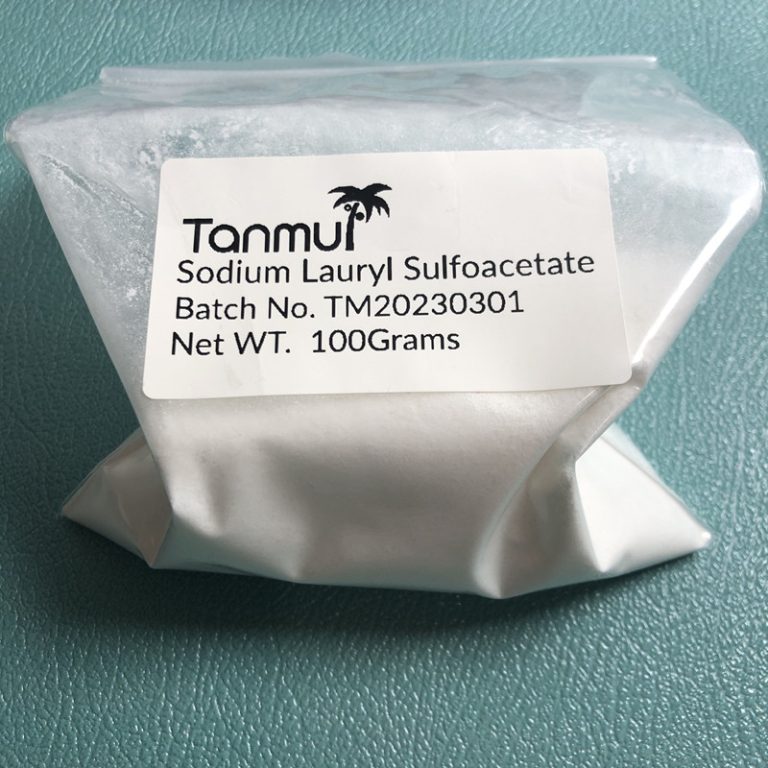 Sodium Lauryl Sulfoacetate (SLSA) – Gentle Surfactant for Premium Personal Care Formulations
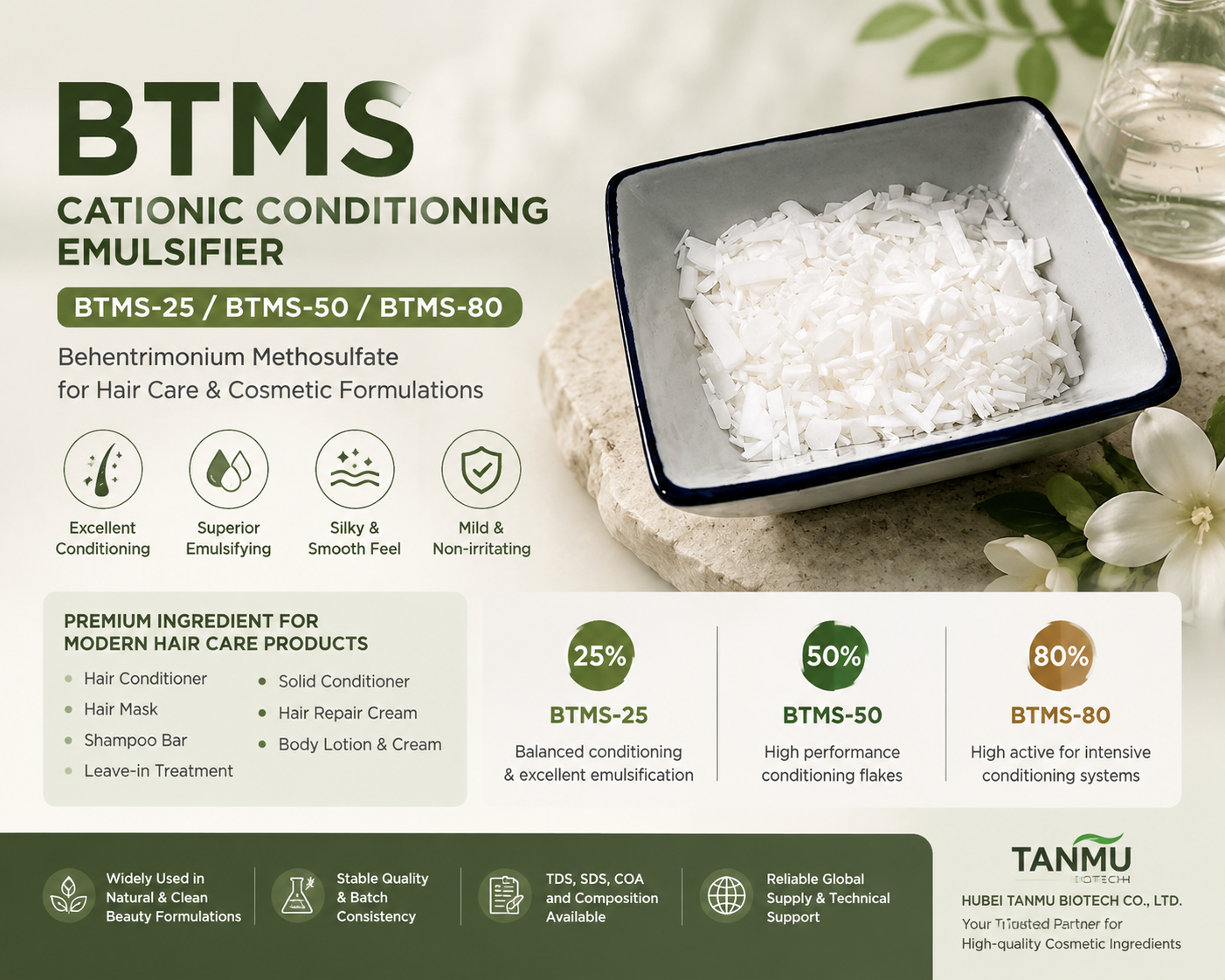 BTMS-25 / BTMS-50 / BTMS-80 Cationic Conditioning Emulsifier Supplier
 Sales Manager
 Sales Manager