Le plan des formulateurs pour le laurylsulfoacétate de sodium (SLSA): Résolution clinique, Formulation, et points sensibles de la chaîne d’approvisionnement
Sur le marché très concurrentiel des soins personnels, développer un produit qui obtient un label sans sulfate tout en conservant des performances luxueuses est l'un des équilibres les plus difficiles à trouver. Les formulateurs sont constamment pris entre deux feux entre les équipes marketing qui exigent des solutions instantanées., mousse explosive explosive, et les toxicologues exigeant des produits ultra-doux, profils non irritants.
Tandis que le laurylsulfoacétate de sodium (SLSA) est largement célébré comme la première solution à ce dilemme, travailler avec lui comporte des défis techniques uniques. De la manipulation de la poussière de poudre dans l'usine de fabrication à la prévention de l'agglutination, gérer la solubilité dans l’eau, et gérer la volatilité mondiale des fournisseurs, les formulateurs sont confrontés à des obstacles critiques.
Ce guide technique aborde ces problèmes de front, délivrer la thermodynamique, de construction, et les solutions pratiques dont vous avez besoin, tout en introduisant le SLSA conçu par TANMUBIOTECH comme votre solution définitive en matière de matières premières.
Point douloureux 1: L’idée fausse sur la dénomination des sulfates
Comment expliquer la sécurité du SLSA aux équipes réglementaires et marketing
Le problème: Parce que le laurylsulfoacétate de sodium contient les mots Lauryl et Sulfo, conseils de réglementation, détaillants de produits de beauté propres, et les consommateurs le confondent souvent avec le laurylsulfate de sodium (SLS). Ce malentendu peut retarder les approbations de produits et compliquer les campagnes marketing..
-
Laurylsulfate de sodium (SLS): A un petit groupe de tête polaire. Pénètre facilement la barrière cutanée, dénature les protéines de la peau, et entraîne des irritations et une sécheresse.
-
Laurylsulfoacétate de sodium (SLSA): A un encombrant, groupe de tête polaire lié par un ester. Un obstacle stérique bloque la pénétration cutanée, garder la molécule en surface pour un nettoyage ultra-doux.
La solution scientifique: La chimie physique des deux molécules est fondamentalement différente. Le SLS est un sulfate d'alkyle avec un petit, groupe de tête hautement polaire. Cette taille compacte lui permet de pénétrer facilement dans la bicouche lipidique de la couche cornée, où il dénature les protéines de la peau et provoque des irritations.
Le SLSA n'est pas un sulfate. C'est un sulfoacétate – un tensioactif lié à un ester organique. L'ajout de la liaison ester (écrit chimiquement comme -CO-O-) et le groupe acétate crée un volumineux, groupe de tête à obstruction stérique (Formule chimique: C14H27NaO5S).
Cet encombrement moléculaire rend le SLSA physiquement trop gros pour pénétrer dans les espaces intercellulaires de la barrière cutanée.. Il nettoie exclusivement à la surface de la peau et des cheveux, balayer la saleté et l'excès de sébum, et se rince complètement sans endommager la délicate barrière contre l'humidité.
Point douloureux 2: Risques liés à la fabrication industrielle (Le problème de la poussière)
Comment manipuler des poudres fines sans compromettre la sécurité de l'usine
Le problème: Le SLSA standard est souvent fourni sous forme de, poudre légère. Lors d'une fabrication à grande échelle, le déversement de ces sacs de poudre dans des récipients de mélange crée une quantité importante de poussière en suspension dans l'air. Cela entraîne de graves risques d'inhalation pour les opérateurs d'usine., contamination croisée dans les environnements de salle blanche, et déchets de matériaux dus à la suspension du produit dans les systèmes d'échappement.
-
Poudre conventionnelle: Crée des risques d'inhalation aéroportée, nécessite des respirateurs lourds pour les opérateurs, et entraîne un gaspillage de matériaux élevé.
-
TANMUBIOTECH Grossier: Poudre grossière solide sans poussière, garantit un sol d'usine propre et sûr, et permet 100 pourcentage d'utilisation active.
La solution TANMUBIOTECH: Pour éliminer ce goulot d’étranglement de fabrication, TANMUBIOTECH a conçu du SLSA granulaire grossier.
En utilisant avancé, technologie d'agglomération sous pression à basse température, nous transformons les fines molécules SLSA en uniformes, granulés grossiers sans poussière. Ce format technique élimine entièrement la poussière en suspension dans l'air (assurer une sécurité, Environnement conforme à l'OSHA pour vos opérateurs d'usine), améliore la fluidité dans les systèmes de trémie automatisés, et évite la perte de matières premières, assurer 100 pour cent de votre matériel acheté finit dans la formulation.
Point douloureux 3: Mauvaise solubilité dans l’eau chaude/froide et agglomération
Surmonter les goulots d'étranglement de dissolution dans le traitement par voie humide
Le problème: Les formulateurs signalent souvent que le SLSA résiste à une dissolution rapide dans l'eau, formant fréquemment des, des grumeaux ressemblant à du gel (phases à cristaux liquides) au fond des récipients de mélange. Cela ralentit les temps de traitement des lots, gaspille de l’énergie en raison d’un chauffage prolongé, et peut conduire à une concentration de matière active incohérente d’un lot à l’autre.
La solution scientifique: Le SLSA est hautement hydrophobe à température ambiante en raison de sa longue queue alkyle en C12. Pour obtenir une fluidité, solution uniforme sans dégradation thermique des autres principes actifs, les formulateurs doivent comprendre son Krafft Point (la température à laquelle la solubilité du tensioactif augmente rapidement à mesure que les micelles se forment).
Protocole de dissolution optimisé
-
Préchauffer l'eau: Amenez votre phase aqueuse à 65 à 70 degrés C avant d'introduire le tensioactif. Ce niveau d'énergie dépasse facilement la limite de Krafft.
-
Ajout progressif: Tamisez lentement le SLSA dans le vortex de l'eau sous cisaillement modéré. (éviter un cisaillement élevé pour éviter un, mousse incontrôlable).
-
Le raccourci du polyol: Si le traitement à chaud n'est pas une option, pré-mettre en suspension la poudre SLSA dans un support polyol (comme la Glycérine ou le Propylène Glycol) à un 1:1 rapport. Le polyol mouille les queues hydrophobes du SLSA, empêchant l'agglutination et permettant au tensioactif de se dissoudre rapidement lorsqu'il est ajouté à l'eau froide.
Point douloureux 4: Les performances par rapport. Compromis de douceur
Comment obtenir une mousse explosive dans les formules sans sulfate
Le problème: De nombreux ultra-doux, tensioactifs sans sulfate (comme les sulfosuccinates ou les glutamates) souffrez d'une mauvaise mousse flash. Les consommateurs attendent des résultats immédiats, riche, et mousse stable, surtout dans les shampoings et les nettoyants pour le corps. Le remplacement des sulfates entraîne souvent un appartement, expérience sensorielle aqueuse.
La solution scientifique: SLSA présente naturellement une mousse flash exceptionnelle, mais ses performances peuvent être renforcées grâce à la thermodynamique micellaire.
Lorsque vous combinez le SLSA anionique avec un co-tensioactif amphotère, comme la Cocamidopropyl Bétaïne (CAPB) ou Coco Bétaïne, vous déclenchez l'auto-assemblage spontané de micelles mixtes.
Ces micelles mixtes regroupées à l'interface liquide-air réduisent considérablement la concentration critique de micelles. (CMC) de votre système. Cette synergie donne:
-
Un instantané, moelleux, et structure en mousse ultra stable.
-
Un profil d’irritation considérablement réduit, car les micelles mixtes se lient aux monomères libres qui autrement interagiraient avec les protéines cutanées.
-
Propriétés améliorées de renforcement de la viscosité, réduisant le besoin de sel synthétique ou d’épaississants de gomme.
Protégez vos formules et vos marges dès aujourd'hui
Ne laissez pas la restructuration du marché, retards d'expédition, et l'augmentation des coûts compromet votre calendrier de production et vos marges bénéficiaires. Transition vers un environnement résilient, supply chain performante avec TANMUBIOTECH.
Devenez partenaire de nous pour votre prochain essai. Contactez notre équipe technico-commerciale pour recevoir un certificat d'analyse (CoA), fiches de données de sécurité (FDS), ou pour commander votre kit d'échantillons gratuit.



 Guide du formulateur du SLSA: Résoudre la solubilité, Saupoudrage & Problèmes de chaîne d'approvisionnement
 Briser le paradoxe des sulfates: Pourquoi le SLSA de haute pureté est l'avenir du nettoyage doux
 Au-delà de la hauteur de la mousse: Comment choisir une poudre SLSA de haute qualité pour les formulations de soins personnels
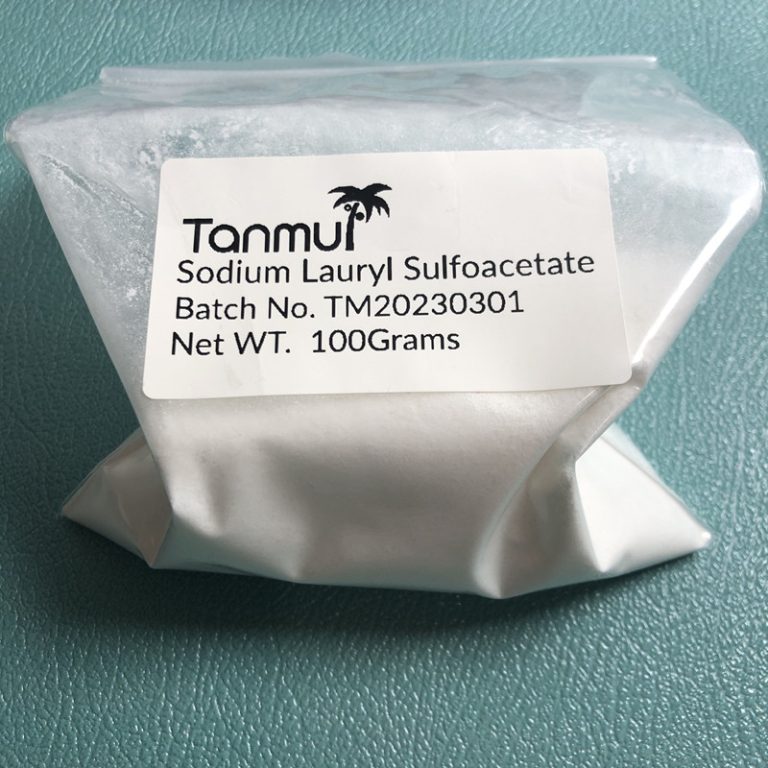 Laurylsulfoacétate de sodium (SLSA) – Tensioactif doux pour les formulations de soins personnels haut de gamme
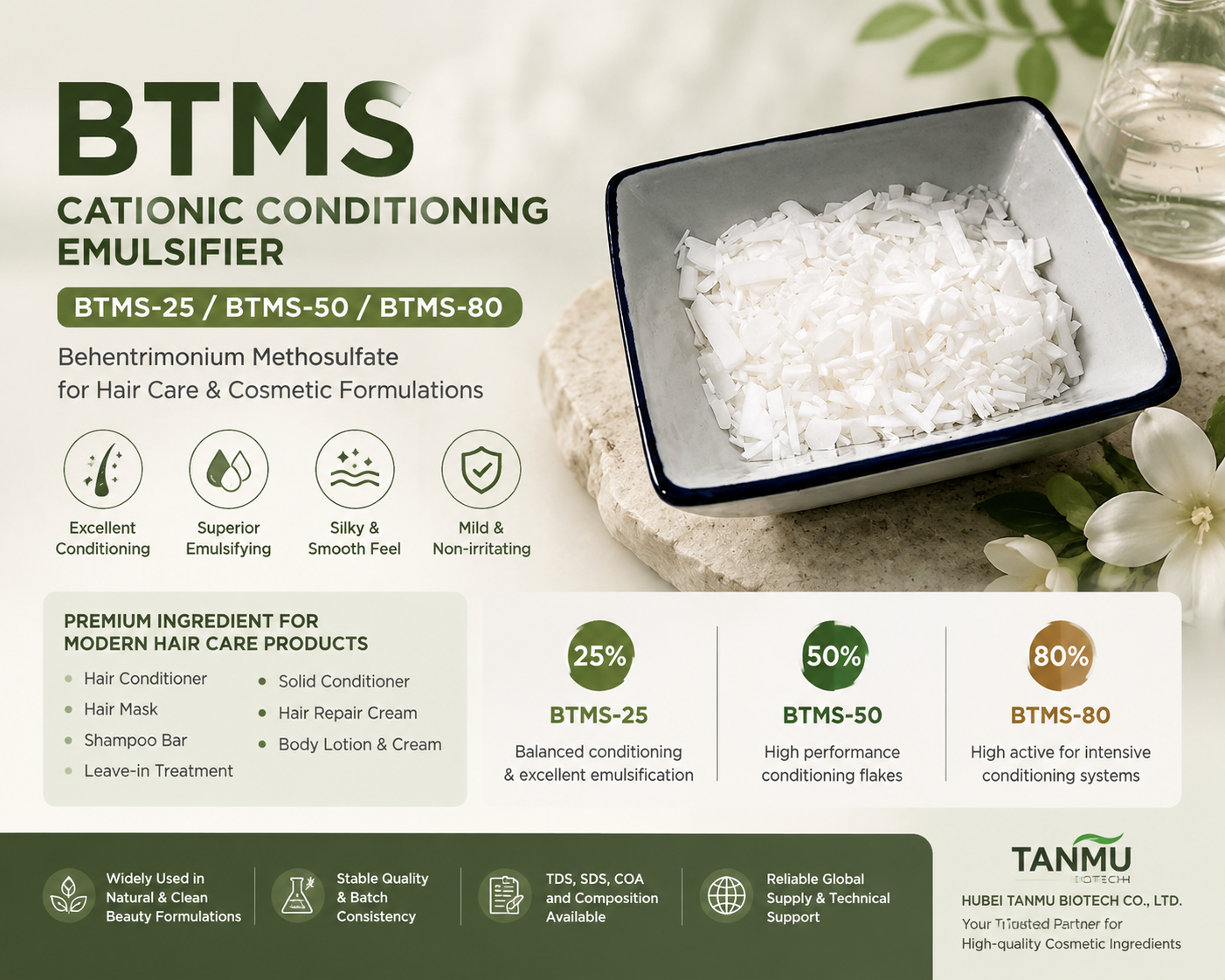 BTMS-25 / BTMS-50 / Fournisseur d'émulsifiant de conditionnement cationique BTMS-80
 Directeur commercial
 Directeur commercial