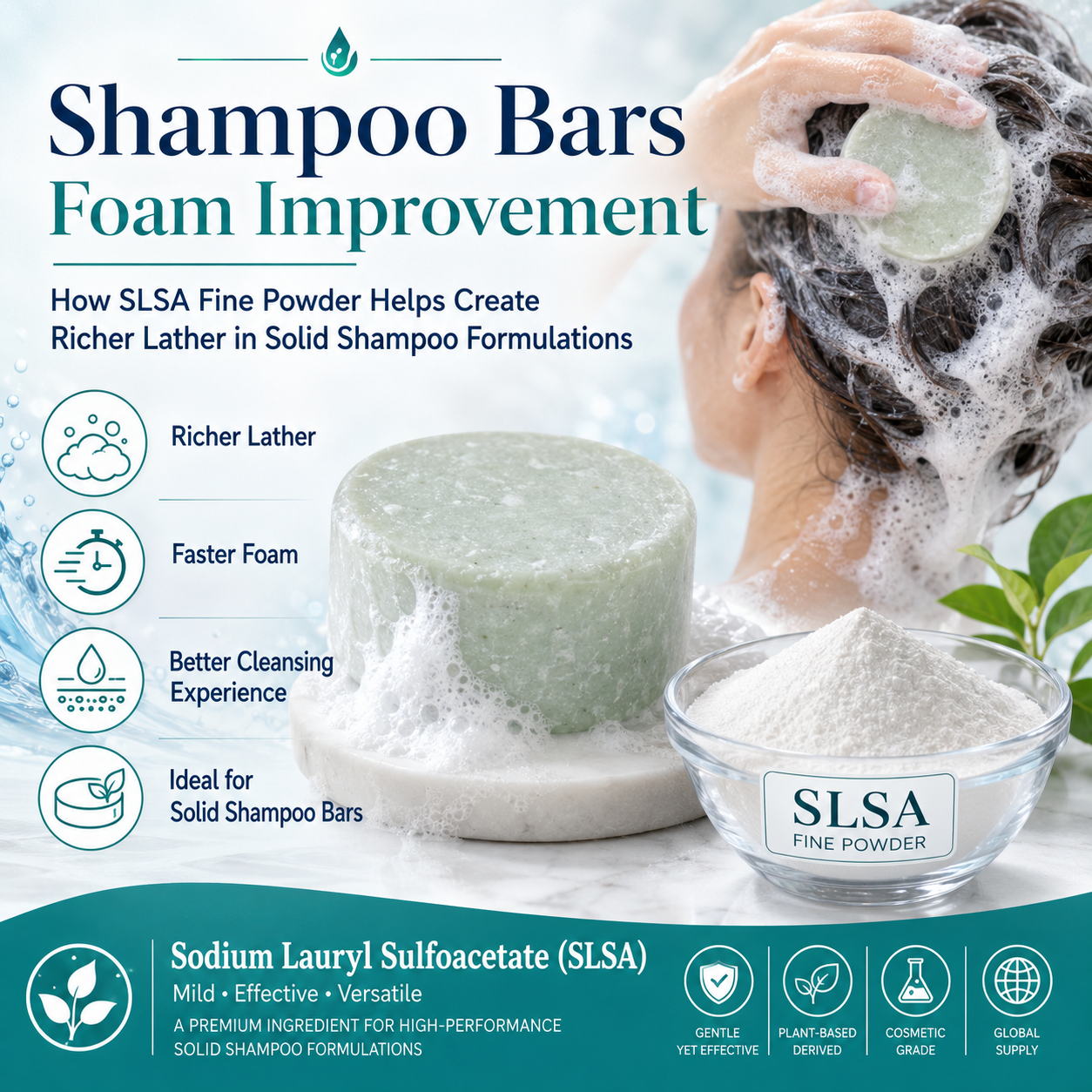
Shampoo Bars Foam Improvement
Foam is one of the most important performance factors in shampoo bars. A shampoo bar may have a beautiful appearance and good ingredients, but if it does not lather well, consumers may feel that the product is difficult to use.
For shampoo bar brands and manufacturers, common foam problems include:
- Slow lathering
- Low foam volume
- Weak foam stability
- Poor spreadability on hair
- Heavy or waxy after-feel
- Difficult rinsing
- Uneven foam between batches
- Consumer complaints about “not enough bubbles”
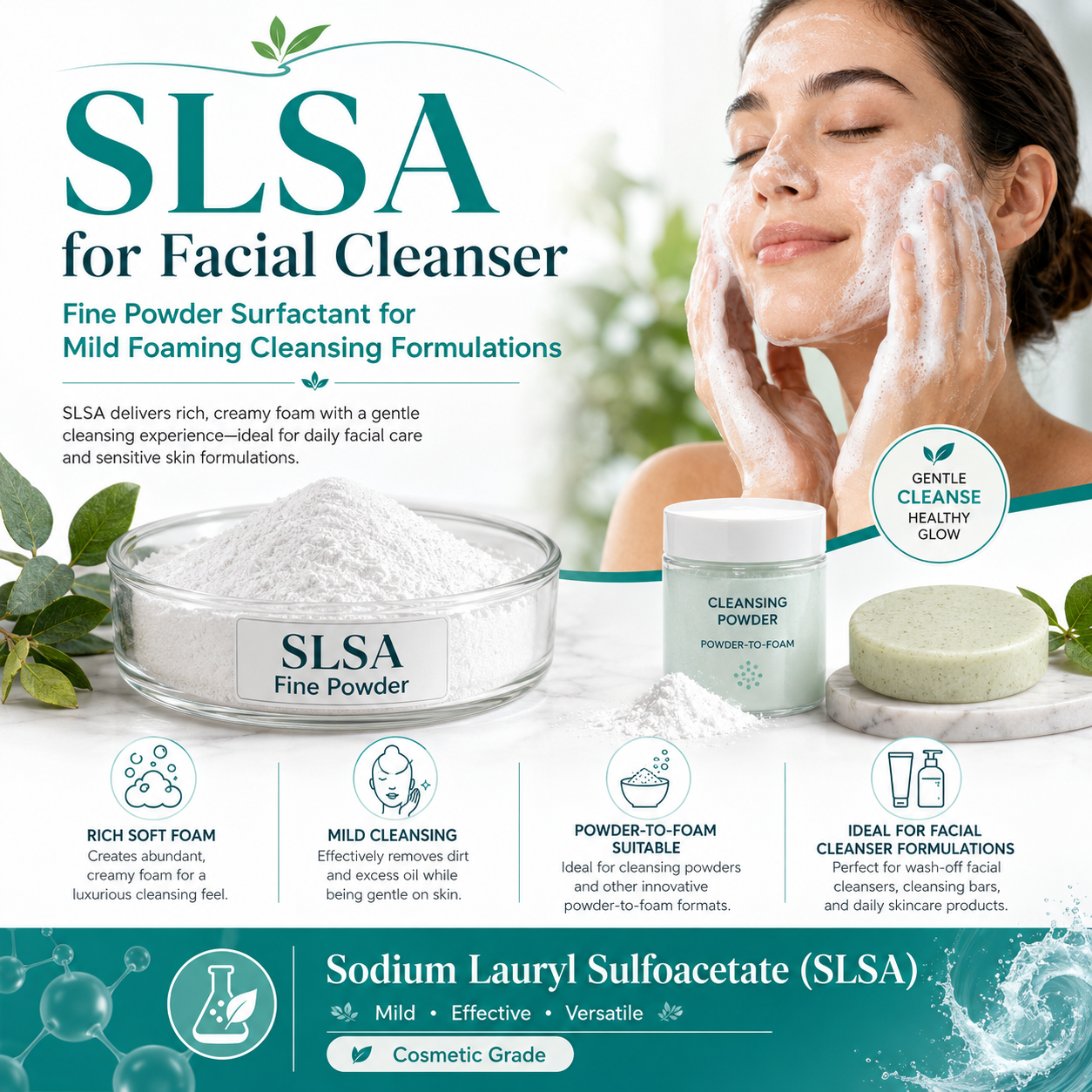
SLSA, also known as Sodium Lauryl Sulfoacetate, is a fine powder anionic surfactant widely used to improve foam and cleansing performance in solid personal care formulations. It is especially suitable for shampoo bars, cleansing bars, bath bombs, cleansing powders, and other waterless personal care products.
Why Foam Matters in Shampoo Bars
Foam does not only affect cleansing performance. It also strongly affects consumer perception.
When consumers use shampoo bars, they usually expect:
- Fast lather
- Rich foam
- Easy spreading through hair
- Smooth washing experience
- Clean rinse-off
- Comfortable scalp feel
- Similar experience to liquid shampoo
If a shampoo bar has poor foam, the user may need to rub the bar for a long time, use more product, or feel that the hair is not being cleaned properly. This can reduce repeat purchase.
For this reason, shampoo bar foam improvement is a key development goal for many brands and OEM manufacturers.
What Causes Poor Foam in Shampoo Bars?
Foam problems in shampoo bars are usually caused by the whole formulation, not only one ingredient.
Common reasons include:
1. Weak Surfactant System
If the surfactant blend is not strong enough, the bar may not create sufficient lather.
2. Too Much Oil or Butter
Oils and butters can improve conditioning and skin feel, but excessive levels may suppress foam.
3. Poor Ingredient Dispersion
If surfactants and powders are not evenly mixed, some bars may foam better than others.
4. Unsuitable Binder System
Binders can affect hardness, dissolution rate, and foam release.
5. Water Hardness
Hard water can reduce foam performance in many cleansing products.
6. High Fragrance or Additive Load
Fragrance, essential oils, clays, pigments, and botanical powders may affect foam.
7. Poor Rinsability
A formula may create foam but still leave a heavy or sticky feel if the surfactant system is not balanced.
To improve shampoo bar foam, formulators need to adjust the surfactant system, oil level, processing method, and final product structure.
How SLSA Helps Improve Shampoo Bar Foam
SLSA fine powder can help improve shampoo bar foam in several practical ways.
1. Increases Foam Volume
SLSA is known for creating rich and abundant foam. When added to shampoo bar formulations, it can help increase visible lather and improve consumer experience.
2. Helps Foam Develop Faster
Consumers prefer shampoo bars that lather quickly. SLSA can help the bar generate foam faster when rubbed with water.
3. Improves Product Spreadability
More foam helps the product spread more easily through hair, especially for users with thick or long hair.
4. Supports Cleansing Performance
SLSA helps remove oil, dirt, and impurities from the hair and scalp. It can improve the cleansing performance of solid shampoo bars.
5. Works Well in Solid Formulations
Because SLSA is supplied as fine powder, it is suitable for dry blending and solid shampoo bar manufacturing.
6. Can Be Used with Other Mild Surfactants
SLSA can be combined with SCI, amino acid surfactants, amphoteric surfactants, or nonionic co-surfactants to build a balanced shampoo bar system.
SLSA as a Foam Booster in Shampoo Bars
SLSA is often used as a foam booster in shampoo bars. It can help improve lather when the main surfactant system does not provide enough foam.
In many shampoo bar formulas, SLSA is used together with other surfactants, such as:
- SCI
- Sodium Cocoyl Isethionate
- Sodium Cocoyl Alaninate
- Cocamidopropyl Betaine
- Decyl Glucoside
- Other mild co-surfactants
The goal is not only to create more foam, but also to improve the overall balance of foam, mildness, cleansing, rinsability, and hair feel.
SLSA and SCI: A Common Combination for Better Foam
SCI is widely used in shampoo bars because it can provide creamy and mild foam. However, some formulas using SCI alone may need additional foam volume or faster lathering.
SLSA can be used with SCI to improve foam performance.
| Item |
SLSA |
SCI |
| Full Name |
Sodium Lauryl Sulfoacetate |
Sodium Cocoyl Isethionate |
| Main Role |
Foam booster and cleansing surfactant |
Mild primary surfactant and creamy foam builder |
| Product Form |
Fine powder |
Powder, noodle, flake, or other forms depending on grade |
| Foam Character |
Rich, abundant foam |
Creamy, dense foam |
| Value in Shampoo Bars |
Improves foam volume and lather speed |
Improves mildness and creamy texture |
A well-designed SLSA + SCI system can help create a shampoo bar with better foam volume, good cleansing performance, and a more pleasant washing experience.
Foam Improvement for Different Shampoo Bar Types
SLSA fine powder can be evaluated in many types of shampoo bars.
Normal Hair Shampoo Bars
SLSA can help create balanced foam and cleansing performance for daily-use shampoo bars.
Oily Hair Shampoo Bars
For oily hair formulas, SLSA can support stronger cleansing and better foam release.
Mild Shampoo Bars
In mild-positioned shampoo bars, SLSA should be used with suitable co-surfactants and conditioning ingredients to balance foam and skin feel.
Clarifying Shampoo Bars
SLSA can help improve cleansing performance in clarifying bars designed to remove oil and buildup.
Waterless Shampoo Bars
Because SLSA is a fine powder, it fits well into waterless and solid shampoo bar formulations.
Private Label Shampoo Bars
For OEM and private label manufacturers, SLSA can help improve formula performance and consumer acceptance across different shampoo bar product lines.
Practical Formulation Tips to Improve Shampoo Bar Foam
1. Balance the Surfactant System
Use SLSA together with other surfactants to create a balanced foam profile. A good shampoo bar should have foam, cleansing, mildness, and rinse-off performance.
2. Control Oil and Butter Levels
Oils and butters can improve conditioning, but too much can reduce foam. Adjust the level carefully.
3. Improve Powder Mixing
SLSA should be evenly distributed in the formula. Uneven mixing can cause inconsistent foam performance between bars.
4. Test Water Hardness
Foam performance can vary in hard and soft water. Test the shampoo bar under real market conditions.
5. Adjust the Binder System
The bar should dissolve enough to release foam, but not become too soft during use.
6. Check pH After Dilution
The final shampoo bar should be tested after dilution to confirm a suitable pH for hair and scalp use.
7. Improve Rinsability
A shampoo bar with rich foam should also rinse cleanly. Poor rinsability may leave hair feeling heavy.
8. Test Fragrance Compatibility
Some fragrances and essential oils can reduce foam. Each fragrance should be tested in the final formula.
9. Control Dust During Production
SLSA is a fine powder, so manufacturers should use suitable dust control and personal protective equipment during handling.
How to Test Shampoo Bar Foam Performance
For commercial production, foam testing should be practical and repeatable.
Manufacturers can compare:
- Foam volume
- Lather speed
- Foam creaminess
- Foam stability
- Spreadability on hair
- Rinsability
- Hair after-feel
- Performance in hard water
- Performance after storage
- Batch-to-batch consistency
Testing should be done with the actual finished shampoo bar, not only the raw material.
Why SLSA Powder Is Suitable for Shampoo Bar Foam Improvement
Hubei Tanmu Biotech supplies Sodium Lauryl Sulfoacetate fine powder. This form is suitable for shampoo bar production because it can be blended into solid and powder-based systems.
SLSA fine powder supports:
- Dry blending
- Solid shampoo bar manufacturing
- Rich foam generation
- Formula flexibility
- Waterless product development
- Consistent application in solid personal care products
For brands looking to improve shampoo bar foam, SLSA fine powder is a useful ingredient to test.
Why Choose Hubei Tanmu Biotech?
Hubei Tanmu Biotech supplies SLSA fine powder for shampoo bars and other personal care formulations.
We support B2B customers with:
- SLSA fine powder supply
- Bulk Sodium Lauryl Sulfoacetate
- Cosmetic-grade surfactant supply
- SDS
- TDS
- COA
- Product specification
- Sample support
- Export packaging
- Stable batch quality
- Long-term cooperation
For shampoo bar manufacturers and personal care ingredient distributors, a reliable SLSA supplier can help reduce sourcing risk and support consistent product performance.
FAQ: Shampoo Bars Foam Improvement
How can I improve foam in shampoo bars?
Foam can be improved by adjusting the surfactant system, reducing excessive oils or butters, improving powder mixing, optimizing the binder system, and testing foam under real use conditions. SLSA fine powder can be used as a foam booster in shampoo bars.
Does SLSA improve shampoo bar foam?
Yes. SLSA helps improve foam volume, lather speed, and cleansing performance in shampoo bar formulations.
Is SLSA good for shampoo bar lather?
Yes. SLSA is widely used in shampoo bars because it helps create rich and creamy lather.
Can SLSA be used with SCI?
Yes. SLSA and SCI are commonly used together in shampoo bars. SCI provides creamy and mild foam, while SLSA can help improve foam volume and cleansing performance.
Why does my shampoo bar not foam well?
Common reasons include weak surfactant balance, too much oil or butter, poor ingredient dispersion, hard water, excessive fragrance, unsuitable binders, or poor formula structure.
Is SLSA suitable for sulfate-free-style shampoo bars?
Yes. SLSA is commonly used in sulfate-free-style shampoo bar formulations. Finished product claims should be checked based on the complete formula and local regulations.
What form of SLSA do you supply?
We supply Sodium Lauryl Sulfoacetate in fine powder form.
Can I request a sample to test shampoo bar foam?
Yes. Samples are recommended for formulation testing before bulk purchase.
Buy SLSA Fine Powder for Shampoo Bar Foam Improvement
Hubei Tanmu Biotech supplies SLSA fine powder for shampoo bars and other solid personal care formulations.
Our SLSA is suitable for:
- Shampoo bars
- Solid cleansing bars
- Cleansing powders
- Bath bombs
- Bubble bath powders
- Facial cleansing bars
- Waterless personal care products
If you are looking for a reliable SLSA manufacturer, Sodium Lauryl Sulfoacetate supplier, or shampoo bar foam booster supplier, contact Hubei Tanmu Biotech for samples, technical documents, and quotation.
Contact Us
Looking to improve foam in your shampoo bars?
Contact Hubei Tanmu Biotech to request:
- SLSA sample
- SLSA quotation
- SDS / TDS / COA
- Product specification
- Shampoo bar foam testing support
- Bulk order information
- Distributor cooperation details
Product: Sodium Lauryl Sulfoacetate
Form: Fine powder
Applications: Shampoo bars, solid cleansing bars, cleansing powders, bath bombs, bubble bath products
Supply Type: Manufacturer direct supply
Contact us today to discuss your SLSA sourcing needs.