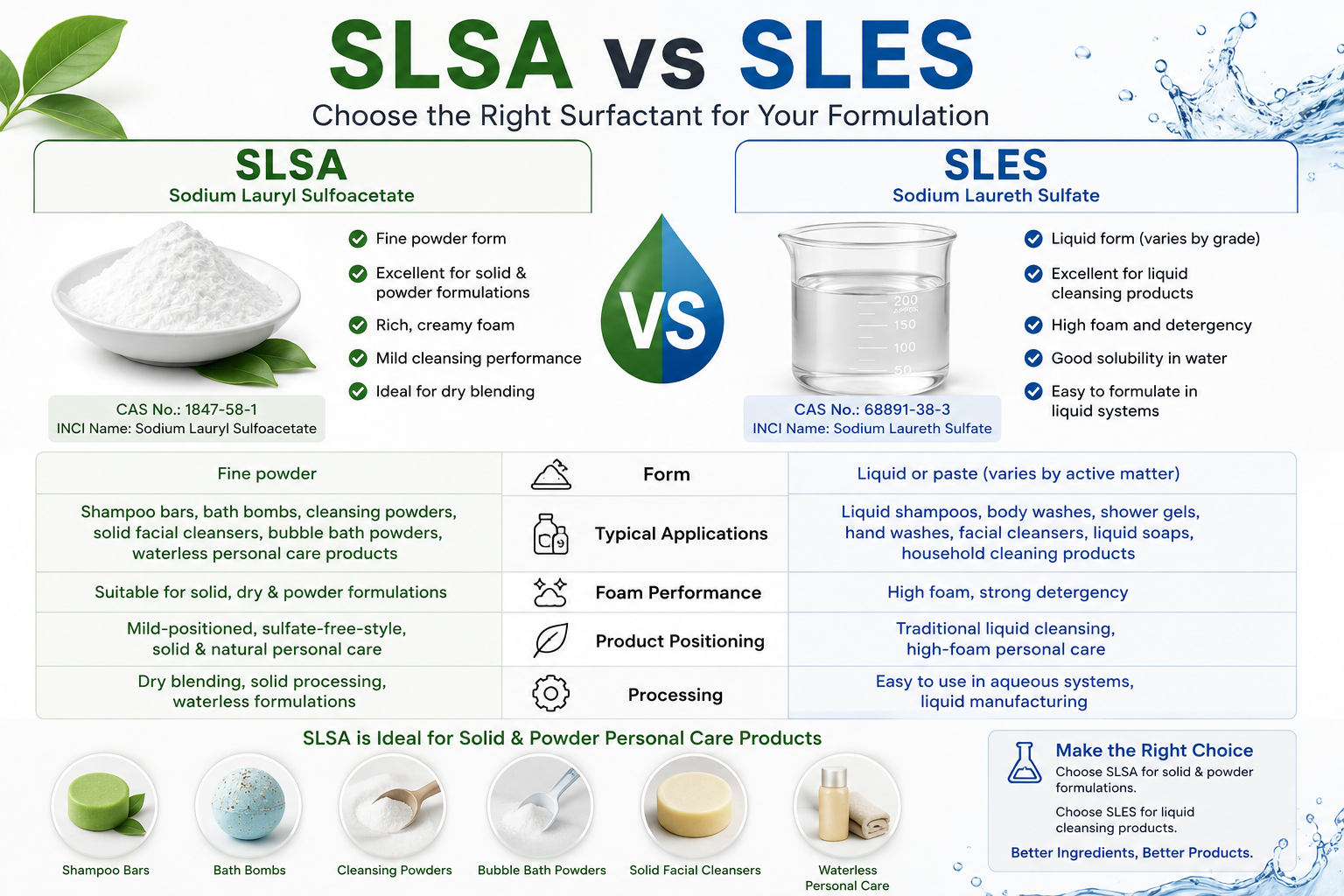
SLSA vs SLS: Are They the Same?
No. SLSA and SLS are not the same ingredient.
SLSA stands for Sodium Lauryl Sulfoacetate, while SLS stands for Sodium Lauryl Sulfate. Although both ingredients are anionic surfactants and both can create foam, they are different substances with different chemical structures, formulation characteristics, and product positioning.
For personal care brands, this difference is important because ingredient choice affects not only foam and cleansing performance, but also marketing claims, consumer perception, and finished product positioning.
If you are developing shampoo bars, bath bombs, facial cleansers, cleansing powders, or sulfate-free-style personal care products, understanding the difference between SLSA and SLS can help you choose a more suitable surfactant system.
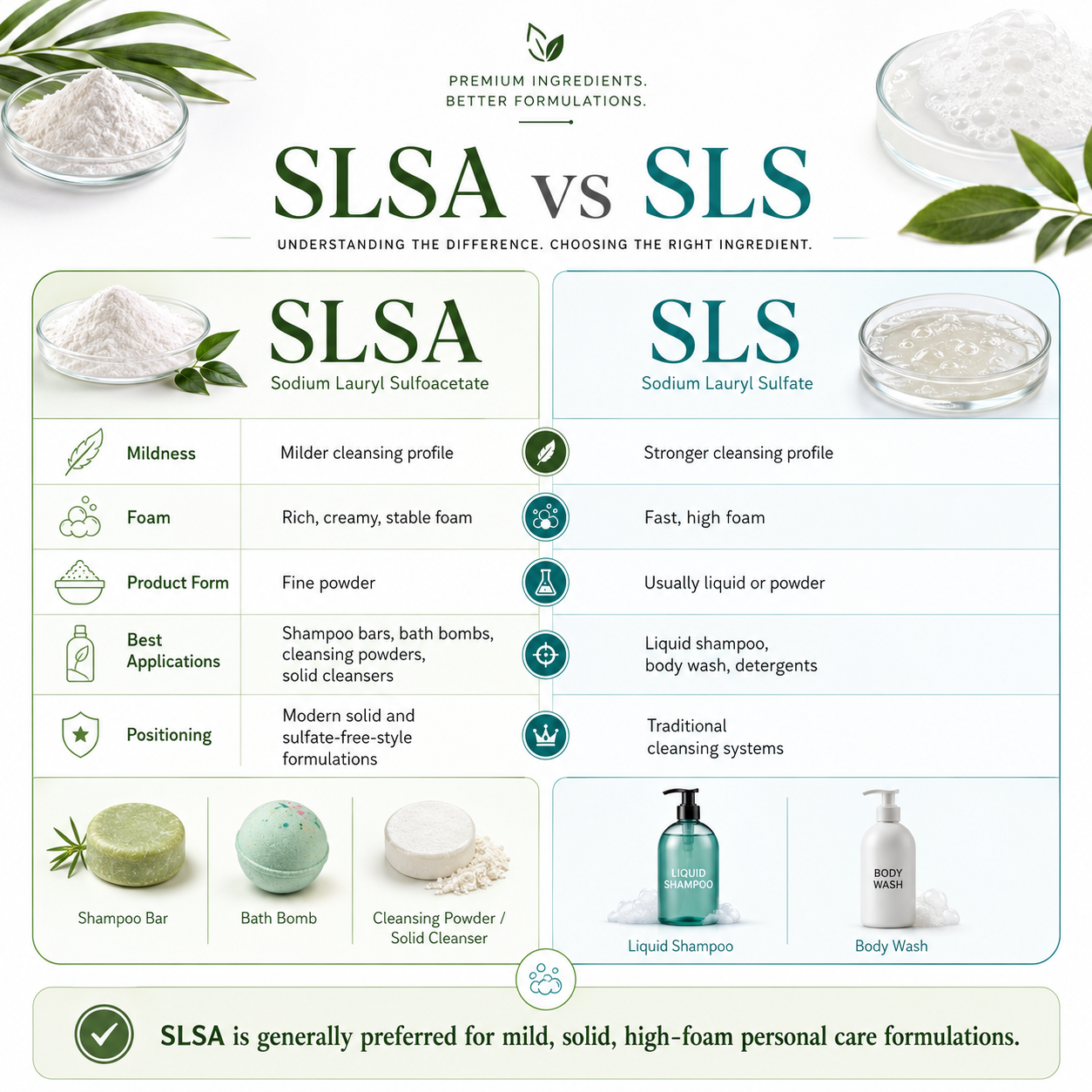
Quick Comparison: SLSA vs SLS
| Item |
SLSA |
SLS |
| Full Name |
Sodium Lauryl Sulfoacetate |
Sodium Lauryl Sulfate |
| INCI Name |
Sodium Lauryl Sulfoacetate |
Sodium Lauryl Sulfate |
| CAS No. |
1847-58-1 |
151-21-3 |
| Surfactant Type |
Anionic surfactant |
Anionic surfactant |
| Main Function |
Cleansing, foaming, wetting |
Cleansing, foaming, detergency |
| Common Form |
Fine powder |
Powder, needle, or liquid blends depending on grade |
| Common Personal Care Use |
Shampoo bars, bath bombs, cleansing powders, facial cleansing bars, bubble bath powders |
Shampoo, body wash, toothpaste, cleansers, detergent-type formulations |
| Product Positioning |
Often used in mild, sulfate-free-style, solid, and waterless formulations |
Often used where strong cleansing and high foam are needed |
| Typical Buyer |
Cosmetic OEM, shampoo bar brand, bath bomb manufacturer, ingredient distributor, formulation lab |
Detergent manufacturer, personal care manufacturer, industrial buyer |
What Is SLSA?
Sodium Lauryl Sulfoacetate, commonly known as SLSA, is a high-foaming anionic surfactant used in personal care and cosmetic formulations. It is especially popular in solid and powder-based products because it is commonly supplied in powder form and can be blended into dry formulations.
SLSA is widely used in:
- Shampoo bars
- Bath bombs
- Bubble bath powders
- Foaming bath salts
- Facial cleansing powders
- Solid cleansing bars
- Body cleansing products
- Waterless personal care formulations
For formulators, SLSA is valued for its rich foam, good cleansing performance, and suitability for modern solid personal care products.
What Is SLS?
Sodium Lauryl Sulfate, commonly known as SLS, is also an anionic surfactant. It is widely used in many cleansing products because it provides strong detergency and abundant foam.
SLS can be found in various product categories, including:
- Shampoos
- Body washes
- Facial cleansers
- Toothpaste
- Household cleaning products
- Industrial cleaning formulations
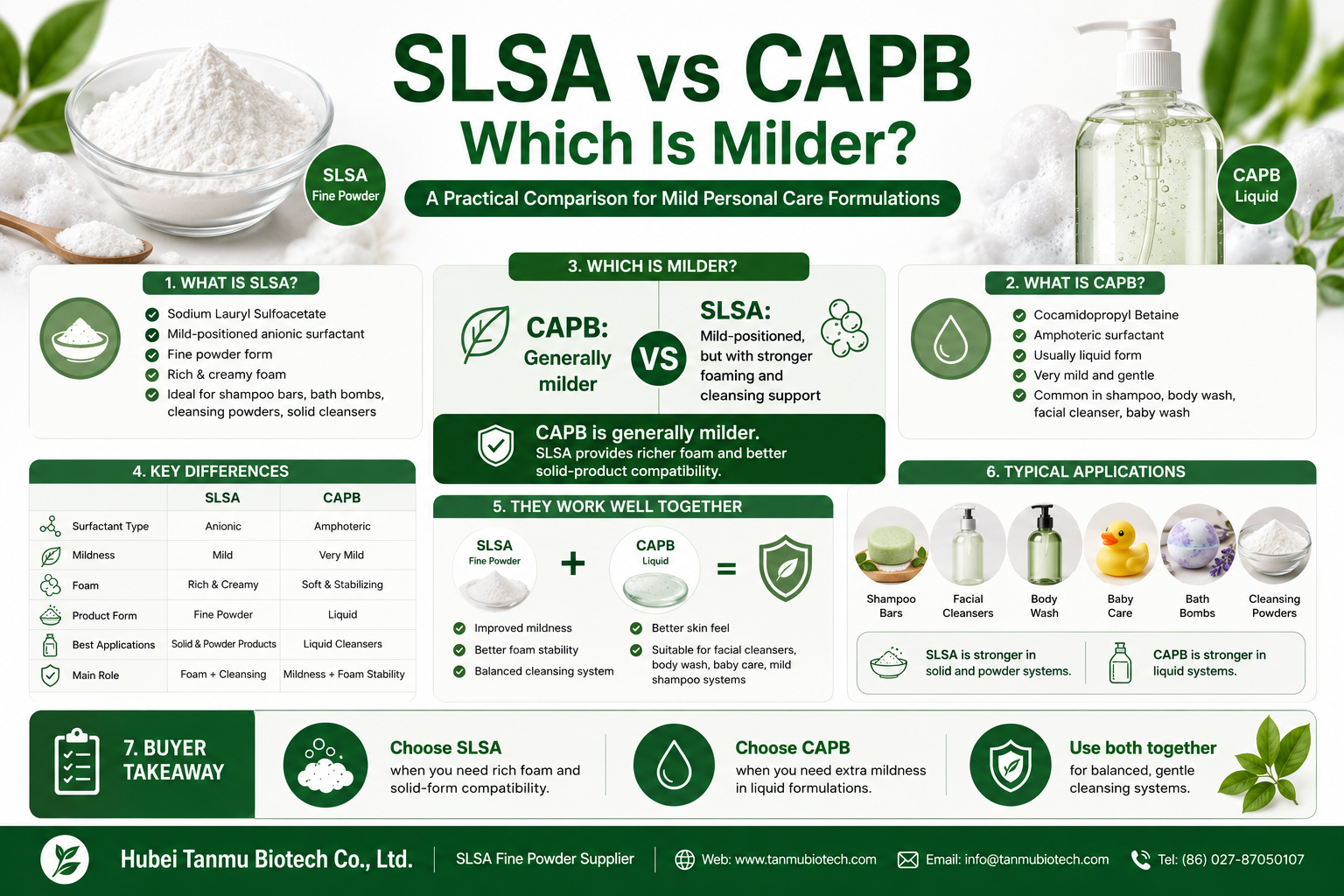
SLS is effective at cleansing and foaming, but it is often perceived by consumers as a stronger surfactant. Because of this, many personal care brands developing mild or sulfate-free-positioned products look for alternative surfactants such as SLSA, SCI, amino acid surfactants, or other mild surfactant systems.
Key Difference 1: SLSA and SLS Have Different Chemical Structures
The biggest difference between SLSA and SLS is that they are chemically different ingredients.
SLSA is Sodium Lauryl Sulfoacetate.
SLS is Sodium Lauryl Sulfate.
Their names sound similar, and both include a lauryl chain, but the functional groups are different. This difference affects how each surfactant behaves in formulations and how each ingredient is positioned in personal care products.
For customers searching “Is SLSA the same as SLS?”, the answer is simple:
No. SLSA is not SLS. Sodium Lauryl Sulfoacetate and Sodium Lauryl Sulfate are two different ingredients.
Key Difference 2: SLSA Is Commonly Used in Sulfate-Free-Style Formulations
Many brands choose SLSA when developing products that are positioned as mild, modern, or sulfate-free-style cleansing products.
SLSA is commonly used in:
- Sulfate-free shampoo bars
- Mild facial cleansing bars
- Bath bombs with rich foam
- Natural-style bath products
- Waterless beauty products
- Powder-to-foam cleansers
- Solid cleansing products
However, formulation claims should always be checked according to the target market, brand policy, and local regulatory requirements. If a brand wants to make a “sulfate-free” claim, it should review the complete formula and confirm whether the claim is suitable for the sales region.
Key Difference 3: SLSA Is Especially Suitable for Solid and Powder Products
One of the main reasons cosmetic manufacturers choose SLSA is its suitability for solid and dry formulations.
Because SLSA is supplied as a fine powder, it can be used in dry blending systems and solid personal care products. This makes it especially useful for:
- Bath bomb production
- Shampoo bar manufacturing
- Cleansing powder formulas
- Bubble bath powder formulas
- Foaming bath salt products
- Solid facial cleanser formulas
For brands developing waterless or plastic-free personal care products, SLSA can be a practical surfactant choice.
Key Difference 4: Foam Feel and Consumer Perception
Both SLSA and SLS can create foam, but they are often used for different product positioning.
SLS is known for strong cleansing and high foam. It is effective, but some consumers associate it with harshness, dryness, or older cleansing systems.
SLSA is often selected when brands want to create a softer marketing message around:
- Mild cleansing
- Rich creamy foam
- Sulfate-free-style formulas
- Shampoo bars
- Bath bombs
- Gentle personal care products
- Solid and waterless beauty
For finished products such as shampoo bars and bath bombs, the foam experience is extremely important. SLSA helps create rich lather and a more pleasant user experience, especially when combined with other surfactants and conditioning ingredients.
Key Difference 5: Buyer Intent Is Different
From a B2B sourcing perspective, buyers searching for SLSA and buyers searching for SLS are often looking for different solutions.
A buyer searching for SLS may be looking for a general-purpose, strong foaming surfactant.
A buyer searching for SLSA is often more likely to be developing:
- Shampoo bars
- Bath bombs
- Facial cleansing powders
- Sulfate-free-style products
- Natural-style personal care formulas
- Waterless beauty products
- Premium bath and body products
This is why SLSA is an important ingredient for cosmetic OEM factories, bath bomb manufacturers, shampoo bar brands, personal care ingredient distributors, and formulation laboratories.
When Should You Choose SLSA Instead of SLS?
You may consider SLSA if your formulation requires:
- Fine powder surfactant form
- Rich foam in solid products
- Good dry blending performance
- Suitability for bath bombs
- Suitability for shampoo bars
- A milder product positioning
- Sulfate-free-style marketing direction
- Waterless or solid personal care format
- Cosmetic-grade surfactant supply
- B2B bulk sourcing with SDS, TDS, and COA support
SLSA is especially suitable for brands that want to develop high-foaming solid personal care products with a more modern ingredient image.
When Is SLS Still Used?
SLS may still be used when a manufacturer needs strong detergency, high foam, and cost efficiency in certain formulations.
It may be suitable for:
- Traditional shampoos
- Body wash formulas
- Household cleaning products
- Industrial cleaning applications
- High-cleansing formulations
However, for brands focused on mildness, clean beauty, sulfate-free-style claims, shampoo bars, bath bombs, or premium personal care, SLSA may be more suitable.
SLSA for Shampoo Bars
SLSA is widely used in shampoo bars because it provides rich foam and supports good cleansing performance. It is often used with other surfactants such as SCI to build a balanced surfactant system.
For shampoo bar manufacturers, SLSA can help improve:
- Foam volume
- Creamy lather
- Cleansing performance
- Consumer experience
- Sulfate-free-style positioning
- Solid bar formulation performance
If your brand produces shampoo bars or solid hair care products, SLSA fine powder can be a valuable ingredient to test.
SLSA for Bath Bombs
SLSA is one of the most common foaming ingredients used in bath bombs and bubble bath powders. It helps create visible foam and improves the bathing experience.
Bath bomb manufacturers often choose SLSA because:
- It is available in fine powder form
- It can be blended with dry ingredients
- It creates rich foam
- It improves product performance
- It fits natural-style bath product positioning
For bath bomb brands, SLSA is often a key ingredient when creating foaming bath bombs, bubble bath bombs, and luxury bath products.
SLSA for Facial Cleansing Powders and Solid Cleansers
SLSA can also be used in facial cleansing powders, solid facial cleansers, and powder-to-foam products. It helps provide foam and cleansing performance in waterless or low-water formulations.
For facial care applications, SLSA is usually used as part of a balanced surfactant system. Formulators should test the final formula for foam, skin feel, pH, rinsability, and mildness.
How to Choose a Reliable SLSA Supplier
When sourcing SLSA for commercial production, buyers should choose a supplier that can provide stable quality and complete documentation.
A reliable SLSA manufacturer or supplier should be able to support:
- Stable SLSA fine powder supply
- Cosmetic-grade quality
- SDS
- TDS
- COA
- Product specification
- Sample testing
- Export packaging
- Batch consistency
- Competitive factory pricing
- Bulk order supply
- Technical communication
For cosmetic OEM factories and personal care brands, quality consistency is very important because differences in powder appearance, moisture, odor, pH, or active matter may affect finished product performance.
FAQ: SLSA vs SLS
Is SLSA the same as SLS?
No. SLSA is Sodium Lauryl Sulfoacetate, while SLS is Sodium Lauryl Sulfate. They are different ingredients.
Is SLSA a surfactant?
Yes. SLSA is an anionic surfactant used for cleansing, foaming, and wetting in personal care formulations.
Is SLSA used in shampoo bars?
Yes. SLSA is widely used in shampoo bars because it helps create rich foam and supports good cleansing performance.
Is SLSA used in bath bombs?
Yes. SLSA is commonly used in bath bombs and bubble bath powders as a foaming ingredient.
Why do brands choose SLSA instead of SLS?
Brands often choose SLSA when developing mild-positioned, sulfate-free-style, solid, or waterless personal care products such as shampoo bars and bath bombs.
Can SLSA replace SLS?
In some formulations, SLSA may be used as part of an alternative surfactant system. However, direct replacement depends on the formula type, target foam, pH, processing method, and final product performance requirements.
What form of SLSA do you supply?
We supply Sodium Lauryl Sulfoacetate in fine powder form, suitable for bath bombs, shampoo bars, cleansing powders, and other personal care formulations.
Can I request SLSA samples?
Yes. Samples can be provided for formulation testing before bulk purchase.
Buy SLSA Fine Powder from Hubei Tanmu Biotech
Hubei Tanmu Biotech supplies Sodium Lauryl Sulfoacetate fine powder for personal care and cosmetic applications.
Our SLSA is suitable for:
- Shampoo bars
- Bath bombs
- Bubble bath powders
- Foaming bath salts
- Facial cleansing powders
- Solid cleansing bars
- Waterless personal care products
We support B2B customers with:
- SLSA fine powder supply
- Bulk Sodium Lauryl Sulfoacetate
- Cosmetic-grade surfactant supply
- SDS
- TDS
- COA
- Product specification
- Sample support
- Export packaging
- Long-term supply cooperation
If you are looking for a reliable SLSA manufacturer, Sodium Lauryl Sulfoacetate supplier, or bulk SLSA powder source, contact Hubei Tanmu Biotech for samples, technical documents, and quotation.
Contact Us
Looking for SLSA fine powder for your shampoo bar, bath bomb, or personal care formulation?
Contact Hubei Tanmu Biotech to request:
- SLSA sample
- SLSA quotation
- SDS / TDS / COA
- Product specification
- Bulk order information
- Distributor cooperation details
Product: Sodium Lauryl Sulfoacetate
Form: Fine powder
Applications: Shampoo bars, bath bombs, cleansing powders, facial cleansers, bubble bath products
Supply Type: Manufacturer direct supply
Contact us today to discuss your SLSA sourcing needs.