SLSA for Baby Care
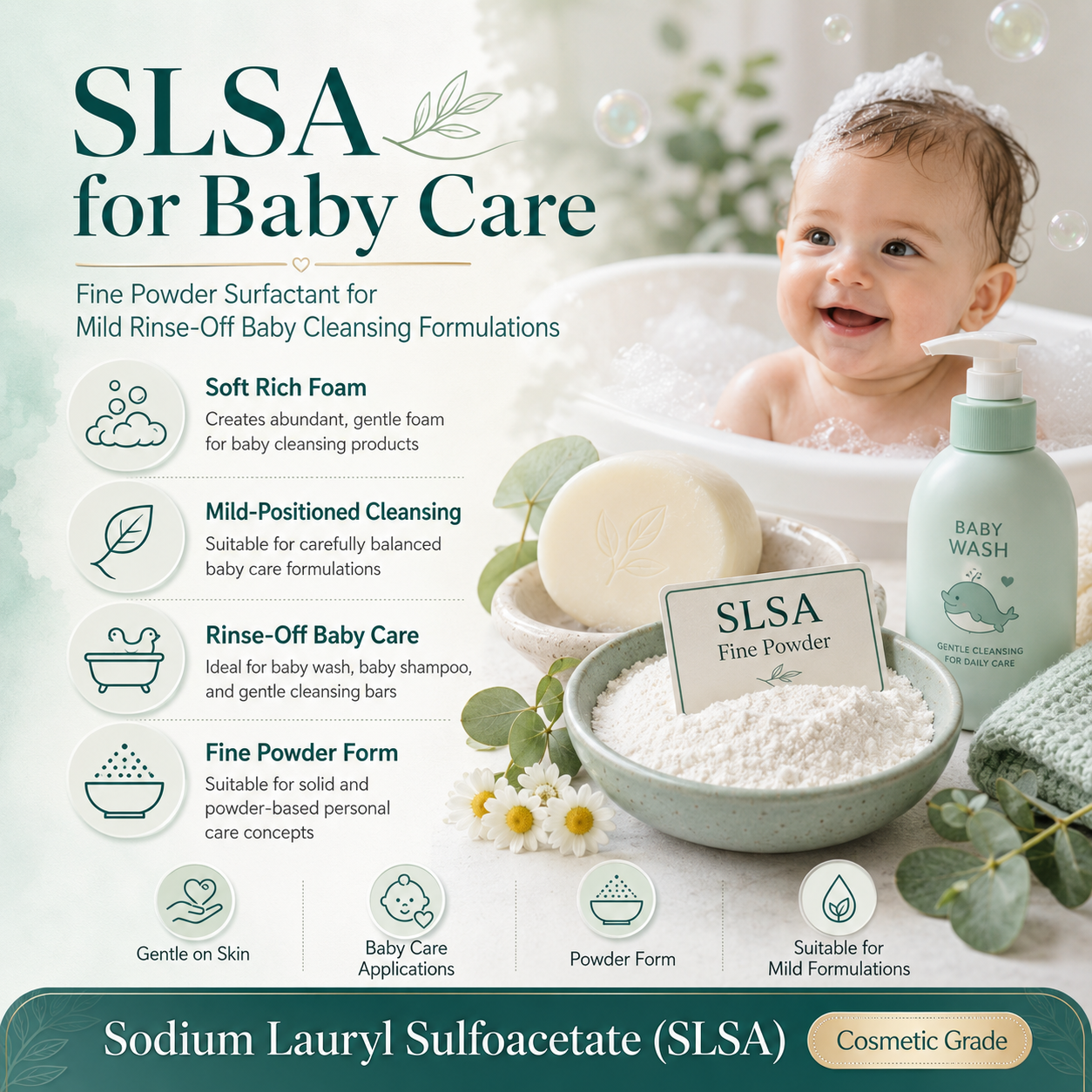
SLSA, also known as Sodium Lauryl Sulfoacetate, is a mild-positioned anionic surfactant used in personal care formulations for foaming, cleansing, wetting, and dispersion.
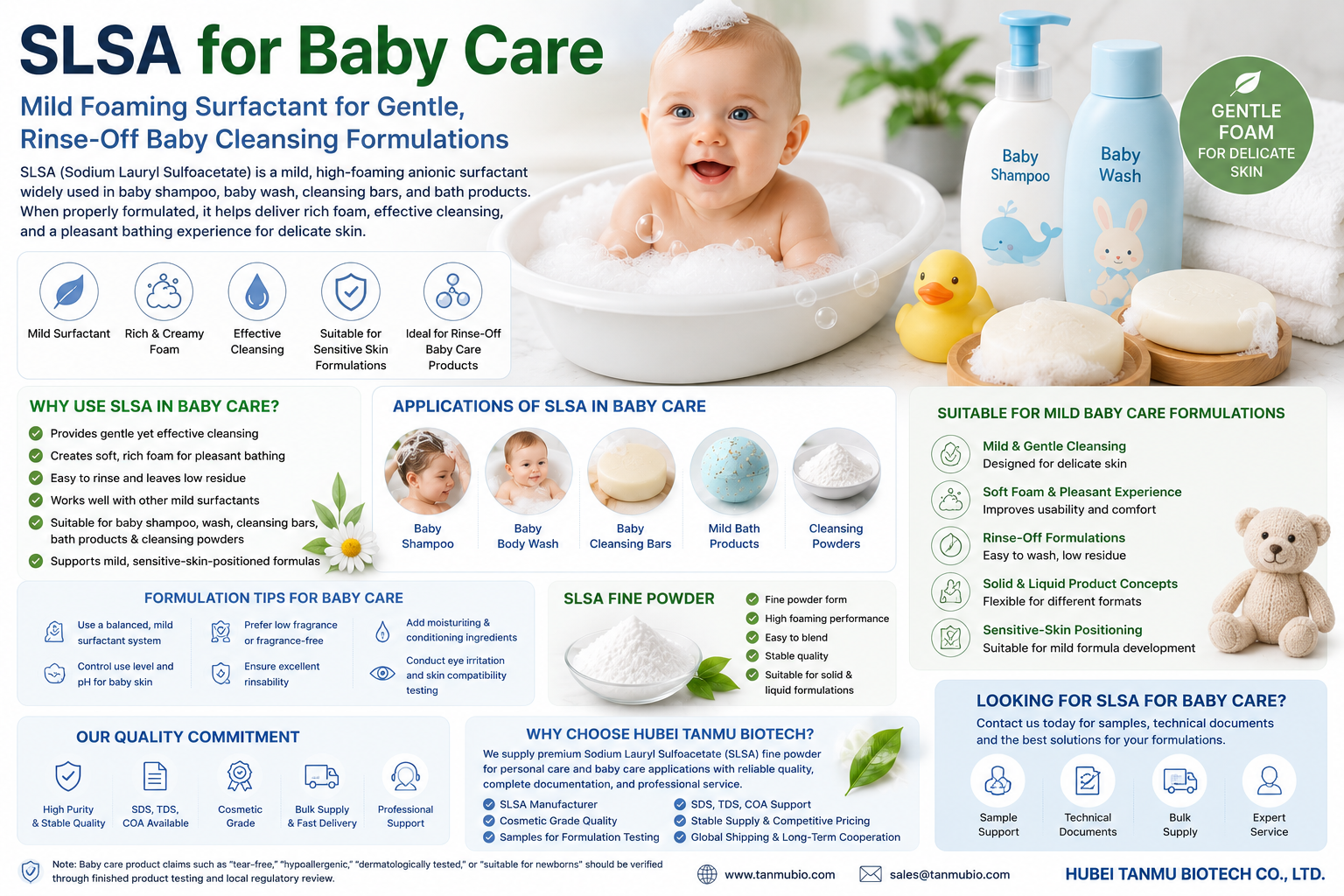
In baby care product development, SLSA can be evaluated as part of a carefully balanced surfactant system for rinse-off cleansing products, such as baby shampoo, baby wash, mild cleansing bars, bath products, and gentle cleansing powders.
Because baby care products are designed for delicate skin, SLSA should not be evaluated alone. The complete formula, use level, pH, fragrance system, preservative system, rinsability, eye irritation potential, and finished product testing should all be considered.
SLSA fine powder can be used in mild-positioned baby care cleansing formulations when properly formulated, tested, and supported by appropriate safety documentation.
Can SLSA Be Used in Baby Care Products?
Yes, SLSA can be evaluated for baby care cleansing products, especially rinse-off formulations. However, baby care is a highly sensitive category, so the final formula must be designed carefully and tested properly.
SLSA may be considered for:
- Baby shampoo
- Baby body wash
- Baby cleansing bars
- Baby bath products
- Mild bath powders
- Gentle cleansing powders
- Sensitive-skin-positioned cleansing products
- Waterless or low-water baby care concepts
For baby care, the goal is not only to create foam. The product should also be mild, easy to rinse, low-residue, and suitable for delicate skin.
Why Use SLSA in Baby Care Formulations?
Baby care products need to balance mildness and performance. Consumers expect baby cleansers to be gentle, but they also expect foam, easy spreading, and effective cleansing.
SLSA can support baby care formulations in several ways.
1. Mild-Positioned Cleansing
SLSA is commonly selected for mild-positioned personal care products. When used properly in a balanced formula, it can help create a gentle cleansing experience in rinse-off products.
2. Rich and Soft Foam
Foam improves product spreadability and user experience. In baby shampoo or baby wash formulas, soft foam can help the product feel pleasant and easy to use.
3. Suitable for Sensitive-Skin Product Concepts
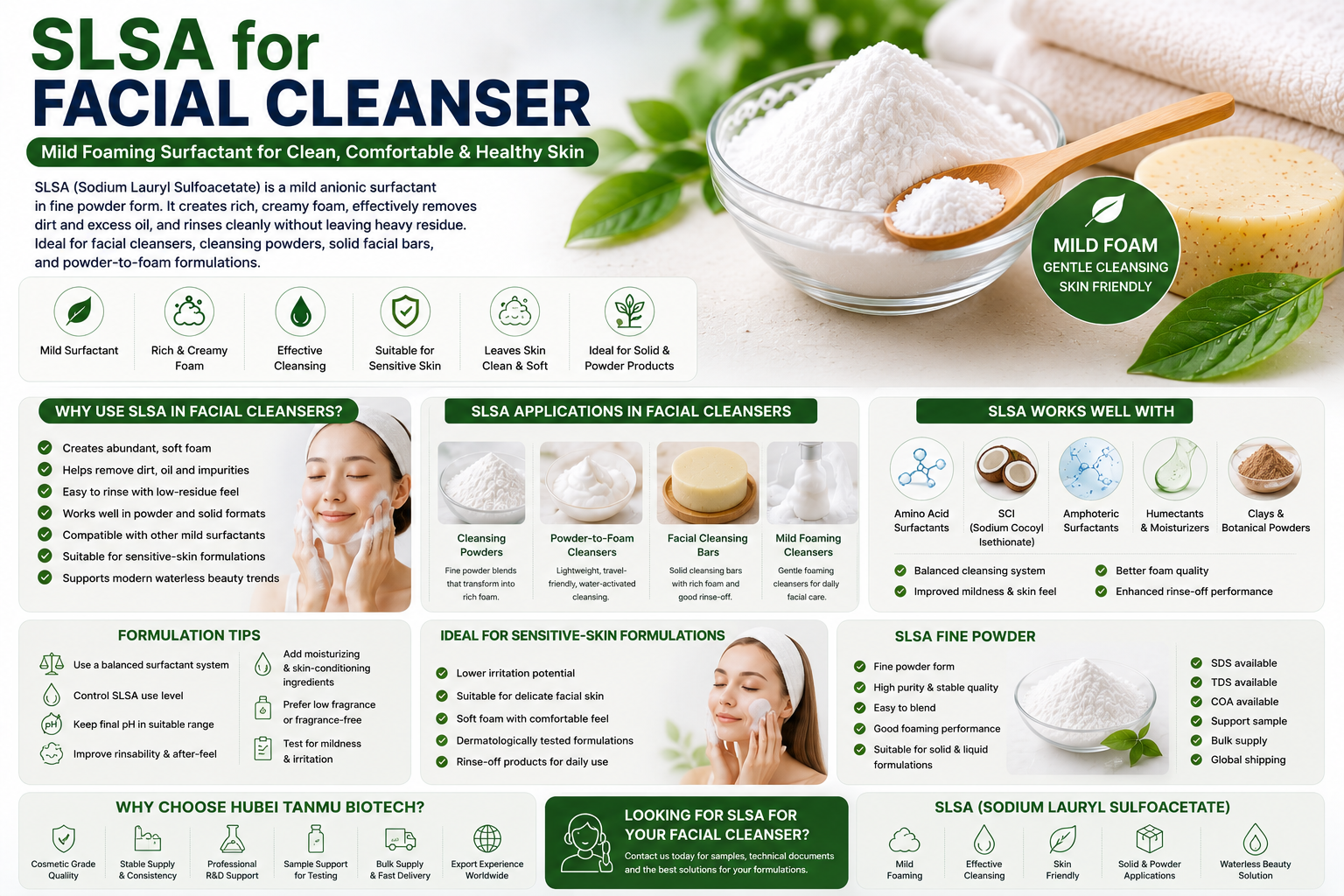
Baby care products are often positioned around delicate skin and gentle cleansing. SLSA can be evaluated in sensitive-skin-positioned formulations when combined with suitable co-surfactants, moisturizers, and conditioning ingredients.
4. Useful in Solid and Powder-Based Formats
Because SLSA is supplied as fine powder, it can be used in solid or powder-based baby care concepts, such as mild cleansing bars or gentle bath powders.
5. Good Compatibility with Modern Personal Care Trends
SLSA can support product concepts such as:
- Mild baby cleansing
- Sensitive-skin-positioned baby care
- Sulfate-free-style baby wash
- Solid baby cleansing bars
- Gentle bath products
- Waterless personal care formats
- Eco-conscious rinse-off products
Important: Baby Care Requires Finished Product Testing
No surfactant should be promoted as “safe for babies” based only on the raw material name. Baby care products require a higher level of formulation responsibility.
Before launching a baby care product, brands should evaluate:
- Full ingredient list
- Total surfactant level
- pH value
- Eye irritation potential
- Skin irritation potential
- Rinsability
- Residue level
- Fragrance or essential oil content
- Preservative system
- Microbiological safety
- Stability
- Packaging compatibility
- Local cosmetic regulations
- Finished product safety assessment
This is especially important for baby shampoo and baby wash products, because these products may contact the scalp, body, and eye area during use.
SLSA for Baby Shampoo
SLSA can be evaluated in baby shampoo formulations when a mild, foaming surfactant system is required.
For baby shampoo, formulators should consider:
- Gentle cleansing level
- Soft foam
- Easy rinsing
- Suitable pH
- Low fragrance or fragrance-free design
- Mild co-surfactants
- Conditioning support
- Eye irritation testing
- Finished product mildness testing
SLSA should normally be used as part of a balanced surfactant blend rather than as the only cleansing ingredient.
SLSA for Baby Wash
Baby body wash products should be mild, easy to rinse, and pleasant to use. SLSA can help create foam and cleansing performance in rinse-off baby wash formulations.
For baby wash products, formulators should pay attention to:
- Skin feel after rinsing
- Moisturizing ingredients
- Low residue
- Mild surfactant balance
- pH control
- Preservative selection
- Fragrance level
- Finished product safety testing
For baby care, foam should be soft and controlled rather than excessively strong.
SLSA for Baby Cleansing Bars
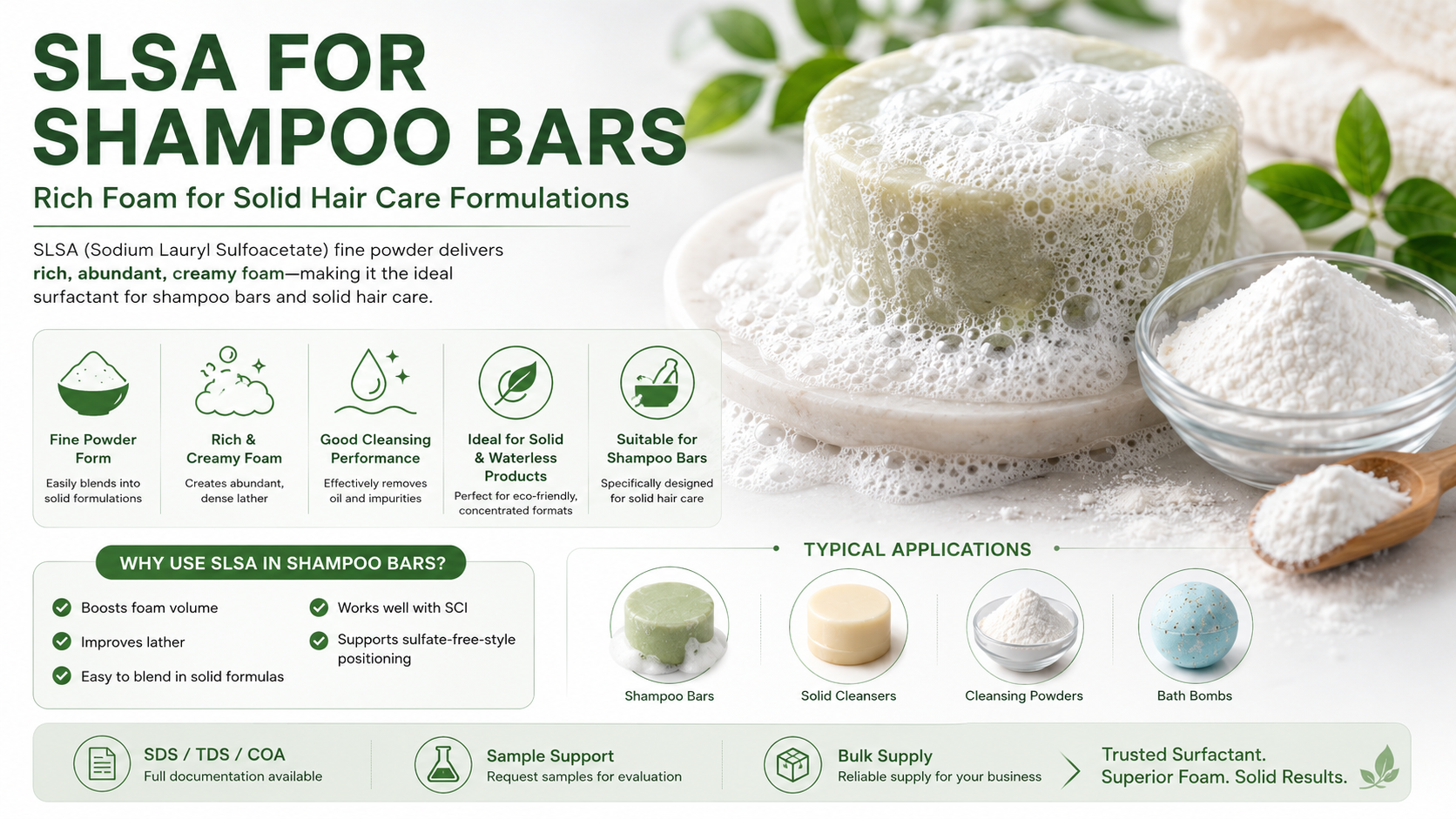
Solid baby cleansing bars are a growing product concept for brands interested in waterless or low-packaging personal care. SLSA fine powder may be evaluated in mild cleansing bar formulations.
In baby cleansing bars, SLSA can help support:
- Foam generation
- Cleansing performance
- Solid format development
- Waterless product positioning
- Gentle rinse-off cleansing
Formulators should also consider bar hardness, mildness, pH after dilution, rinsability, and moisturization.
SLSA for Baby Bath Products
SLSA can also be evaluated in gentle bath products where mild foam is desired.
Possible applications include:
- Baby bath powders
- Mild bubble bath powders
- Gentle foaming bath products
- Low-fragrance bath products
- Sensitive-skin-positioned bath products
For baby bath products, foam should not be the only focus. The formula should be carefully designed to minimize irritation potential and support comfortable rinsing.
SLSA vs SLS in Baby Care
SLSA and SLS are different ingredients.
SLSA is Sodium Lauryl Sulfoacetate.
SLS is Sodium Lauryl Sulfate.
SLS is a widely used surfactant, but consumers often associate it with stronger cleansing and potential dryness. For baby care and sensitive-skin-positioned products, many formulators prefer to evaluate milder-positioned surfactant systems.
SLSA may be considered when a brand wants to develop:
- Mild baby shampoo
- Gentle baby wash
- Sensitive-skin-positioned baby cleanser
- Sulfate-free-style baby care products
- Solid or powder-based baby cleansing products
However, the suitability of any surfactant depends on the full formula and testing.
Is SLSA Tear-Free?
SLSA itself should not be described as “tear-free” without finished product testing.
“Tear-free” is a finished product claim. It depends on:
- Complete surfactant system
- pH
- Use level
- Eye irritation potential
- Rinsability
- Fragrance and additives
- Preservative system
- Ophthalmological testing
- Local regulatory and retailer requirements
A responsible B2B statement is:
SLSA can be evaluated in mild baby shampoo and baby wash formulations, but tear-free claims should only be made after appropriate finished product testing.
Is SLSA Suitable for Sensitive Baby Skin?
SLSA may be suitable for sensitive-skin-positioned baby care formulations when properly used. However, baby skin is delicate, and individual tolerance can vary.
For sensitive baby skin products, formulators should consider:
- Low total surfactant strength
- Mild co-surfactants
- Suitable pH
- Fragrance-free or low-fragrance design
- Moisturizing ingredients
- Good rinsability
- No unnecessary colorants
- Finished product irritation testing
- Dermatological testing if required
The key point is that sensitive-skin suitability must be proven by the final product, not by one raw material alone.
Recommended Formulation Approach
When using SLSA in baby care products, a balanced formula is essential.
A baby care cleansing formula may include:
- Primary mild surfactant
- SLSA as a foam-supporting surfactant
- Amphoteric co-surfactant
- Nonionic co-surfactant
- Humectant
- Mild conditioning ingredient
- pH adjuster
- Preservative system
- Low fragrance or no fragrance
- Skin-feel enhancer
- Water or solid-format base depending on product type
The exact formula should be developed and tested according to the target product and target market.
Formulation Tips for Baby Care Products with SLSA
1. Use a Mild Surfactant Blend
Avoid relying on one surfactant alone. Combining SLSA with mild co-surfactants may help improve skin feel and reduce harshness.
2. Control the Use Level
Use level should be carefully evaluated based on the product type and target mildness.
3. Adjust the pH
The final product pH should be tested and adjusted for baby skin and scalp compatibility.
4. Reduce Fragrance Load
Baby care products often benefit from fragrance-free or very low-fragrance design.
5. Improve Rinsability
The formula should rinse cleanly and avoid leaving heavy residue.
6. Avoid Unnecessary Additives
Strong colors, excessive botanical extracts, high essential oil levels, and aggressive actives may increase sensitivity risk.
7. Conduct Finished Product Testing
Finished product testing is essential for baby care claims, including stability, microbiology, mildness, eye irritation, and skin tolerance testing where required.
FAQ: SLSA for Baby Care
Can SLSA be used in baby care products?
Yes. SLSA can be evaluated in baby care rinse-off cleansing products, but the final formula must be properly designed, tested, and supported by safety documentation.
Is SLSA suitable for baby shampoo?
SLSA may be evaluated in baby shampoo formulations as part of a mild surfactant system. Eye irritation and finished product testing are important.
Is SLSA suitable for baby wash?
Yes. SLSA can be evaluated in baby wash products when used in a balanced, mild-positioned rinse-off formulation.
Is SLSA tear-free?
SLSA itself should not be described as tear-free. Tear-free is a finished product claim and should be supported by appropriate testing.
Is SLSA safe for baby skin?
SLSA can be used in cosmetic formulations under appropriate conditions, but baby care suitability depends on the complete formula, use level, pH, rinsability, and finished product testing.
Is SLSA the same as SLS?
No. SLSA is Sodium Lauryl Sulfoacetate, while SLS is Sodium Lauryl Sulfate. They are different ingredients.
What form of SLSA do you supply?
We supply Sodium Lauryl Sulfoacetate in fine powder form.
What documents can you provide?
We can provide SDS, TDS, COA, and product specification. Additional statements can be discussed according to customer requirements.
Can I request a sample for baby care formulation testing?
Yes. Samples are recommended for formulation testing before bulk purchase.
Buy SLSA Fine Powder for Baby Care Formulations
Hubei Tanmu Biotech supplies Sodium Lauryl Sulfoacetate fine powder for personal care and cosmetic applications.
Our SLSA can be evaluated in:
- Baby shampoo
- Baby body wash
- Baby cleansing bars
- Mild bath products
- Cleansing powders
- Sensitive-skin-positioned products
- Waterless personal care formulations
We support B2B customers with:
- SLSA fine powder supply
- Bulk Sodium Lauryl Sulfoacetate
- Cosmetic-grade surfactant supply
- SDS
- TDS
- COA
- Product specification
- Sample support
- Export packaging
- Long-term supply cooperation
If you are developing mild baby care products or sensitive-skin-positioned cleansing formulations, contact Hubei Tanmu Biotech for samples, technical documents, and quotation.
Note: Baby care product claims such as “tear-free,” “hypoallergenic,” “dermatologically tested,” or “suitable for newborns” should be verified through finished product testing and local regulatory review.
Contact Us
Looking for SLSA fine powder for baby care or mild personal care formulations?
Contact Hubei Tanmu Biotech to request:
- SLSA sample
- SLSA quotation
- SDS / TDS / COA
- Product specification
- Baby care formulation support
- Bulk order information
- Distributor cooperation details
Product: Sodium Lauryl Sulfoacetate
Form: Fine powder
Applications: Baby shampoo, baby wash, cleansing bars, bath products, cleansing powders, sensitive-skin products
Supply Type: Manufacturer direct supply
Contact us today to discuss your SLSA sourcing needs.



 Sales Manager
 Sales Manager