SLSA vs SCI: Overview
SLSA (Sodium Lauryl Sulfoacetate) and SCI (Sodium Cocoyl Isethionate) are two of the most widely used surfactants in solid personal care formulations, especially:
- Shampoo bars
- Facial cleansing bars
- Body cleansing bars
- Bath products
Although both are used in similar applications, they play different roles in formulation systems.
🧴 What is SLSA?
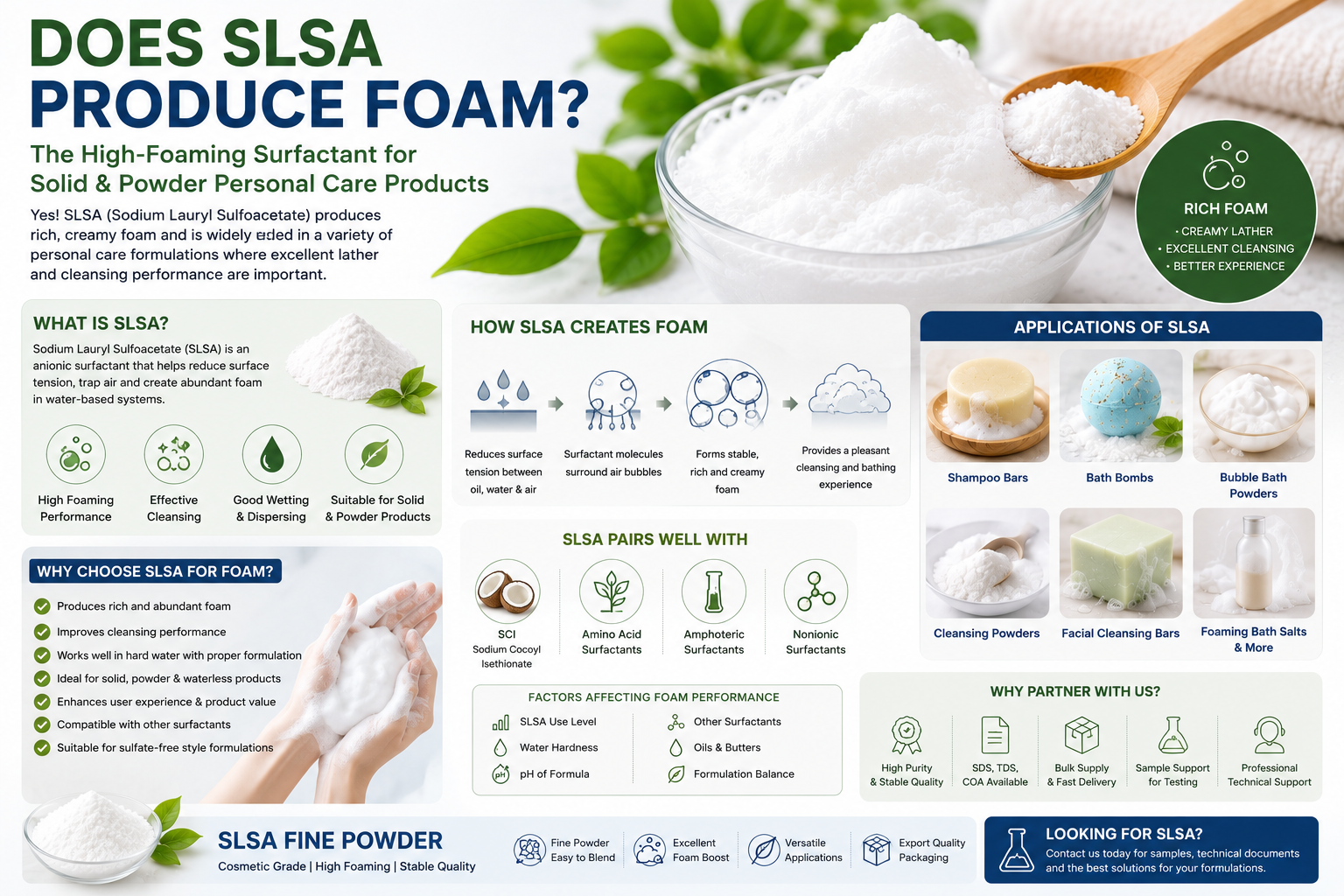
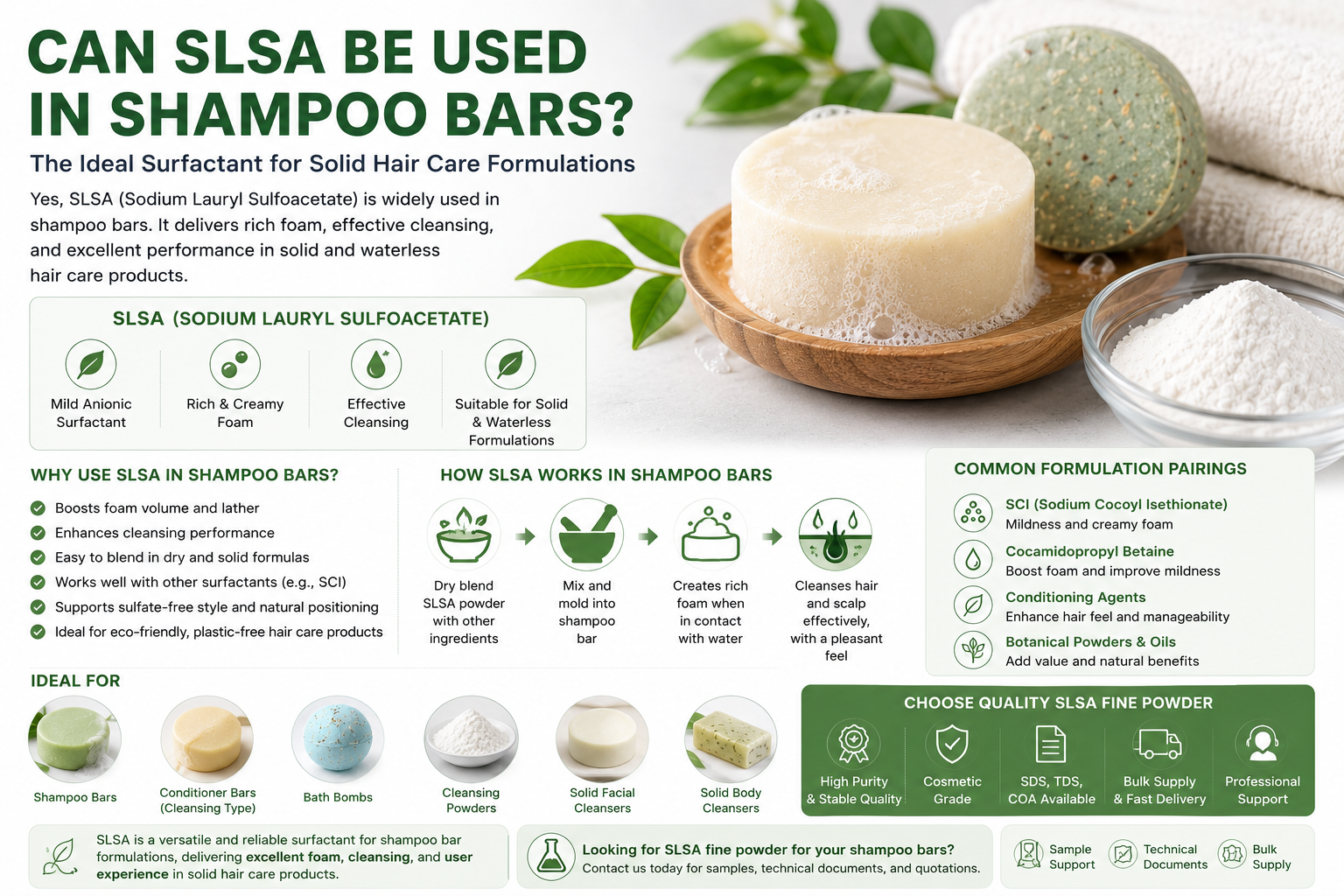
SLSA is a high-foaming anionic surfactant supplied in fine powder form.
It is commonly used for:
- Foam boosting
- Cleansing support
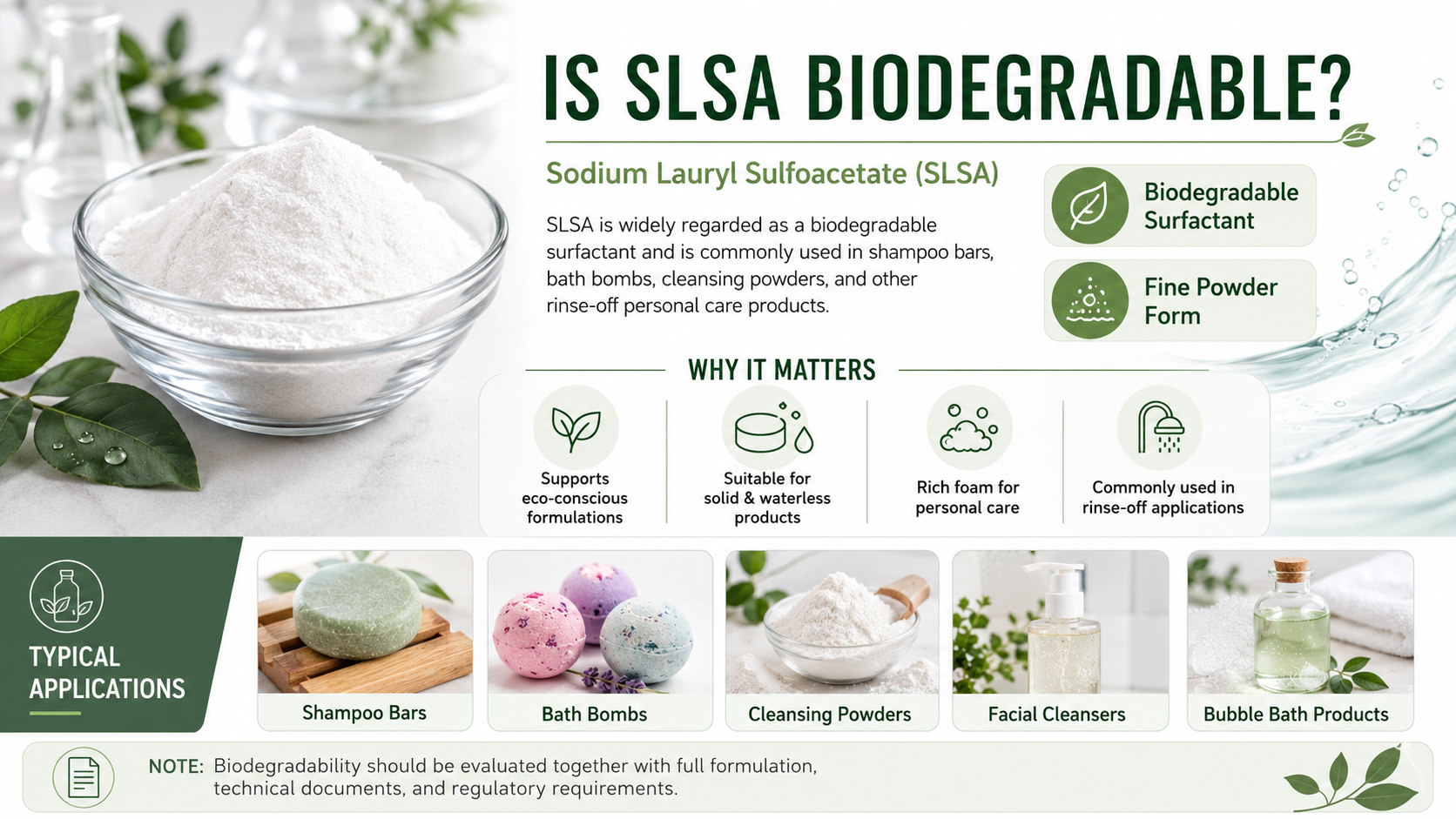
- Bath bombs
- Shampoo bars
- Cleansing powders
Key characteristics:
- Rich, abundant foam
- Strong lather generation
- Fine powder form (ideal for dry blending)
- Excellent compatibility in solid systems
👉 SLSA is mainly a foam performance enhancer + cleansing surfactant
🧴 What is SCI?
SCI (Sodium Cocoyl Isethionate) is a mild primary surfactant derived from fatty acids.
It is widely used in:
- Shampoo bars
- Facial cleansing bars
- Body cleansing bars
Key characteristics:
- Very mild cleansing performance
- Creamy, dense foam
- Excellent skin compatibility
- Available in powder / noodle / flake forms
👉 SCI is mainly a primary mild surfactant base ingredient
⚖️ SLSA vs SCI: Key Differences
| Feature |
SLSA |
SCI |
| Surfactant Type |
Anionic surfactant |
Mild anionic surfactant |
| Main Role |
Foam booster + cleansing support |
Primary mild surfactant |
| Foam Type |
Rich, airy foam |
Creamy, dense foam |
| Mildness |
Moderate mild positioning |
Very mild |
| Product Form |
Fine powder |
Powder / noodle / flake |
| Best Use |
Foam enhancement systems |
Base surfactant in solid cleansers |
| Applications |
Shampoo bars, bath bombs, powders |
Shampoo bars, facial bars, body bars |
🫧 Foam Difference: SLSA vs SCI
SLSA Foam Characteristics
- High foam volume
- Fast lather generation
- Light, airy texture
- Strong visual foam effect
SCI Foam Characteristics
- Creamy and dense foam
- Slower but smoother lather
- Luxurious skin feel
- More conditioning effect
👉 Simple summary:
- SLSA = volume + speed of foam
- SCI = creaminess + skin feel
🧴 How They Work in Shampoo Bars
In modern shampoo bar systems:
SCI is the foundation:
- Provides mild cleansing base
- Improves skin feel
- Supports formula stability
SLSA is the performance booster:
- Enhances foam volume
- Improves lather speed
- Strengthens user experience
👉 Many high-performance shampoo bars use:
SCI + SLSA combination system
Looking for Sodium Lauryl Sulfoacetate SLSA for bath bombs, shampoo bars or mild cleansing formulations? Tanmu Biotech supplies SLSA fine powder and coarse powder with COA, TDS and SDS available.
Request SLSA Sample / Get SLSA Quotation
🧪 Formulation Synergy (Very Important)
SLSA and SCI are not competitors — they are complementary surfactants.
When combined, they can create:
- Balanced foam system
- Better cleansing performance
- Improved user experience
- Stronger shampoo bar structure
🧼 Application Comparison
Where SLSA is preferred:
- Bath bombs
- Foam boosters
- Powder cleansers
- Fast-lather shampoo bars
Where SCI is preferred:
- Facial cleansing bars
- Mild shampoo bars
- Baby / sensitive skin bars
- Premium solid cleansers
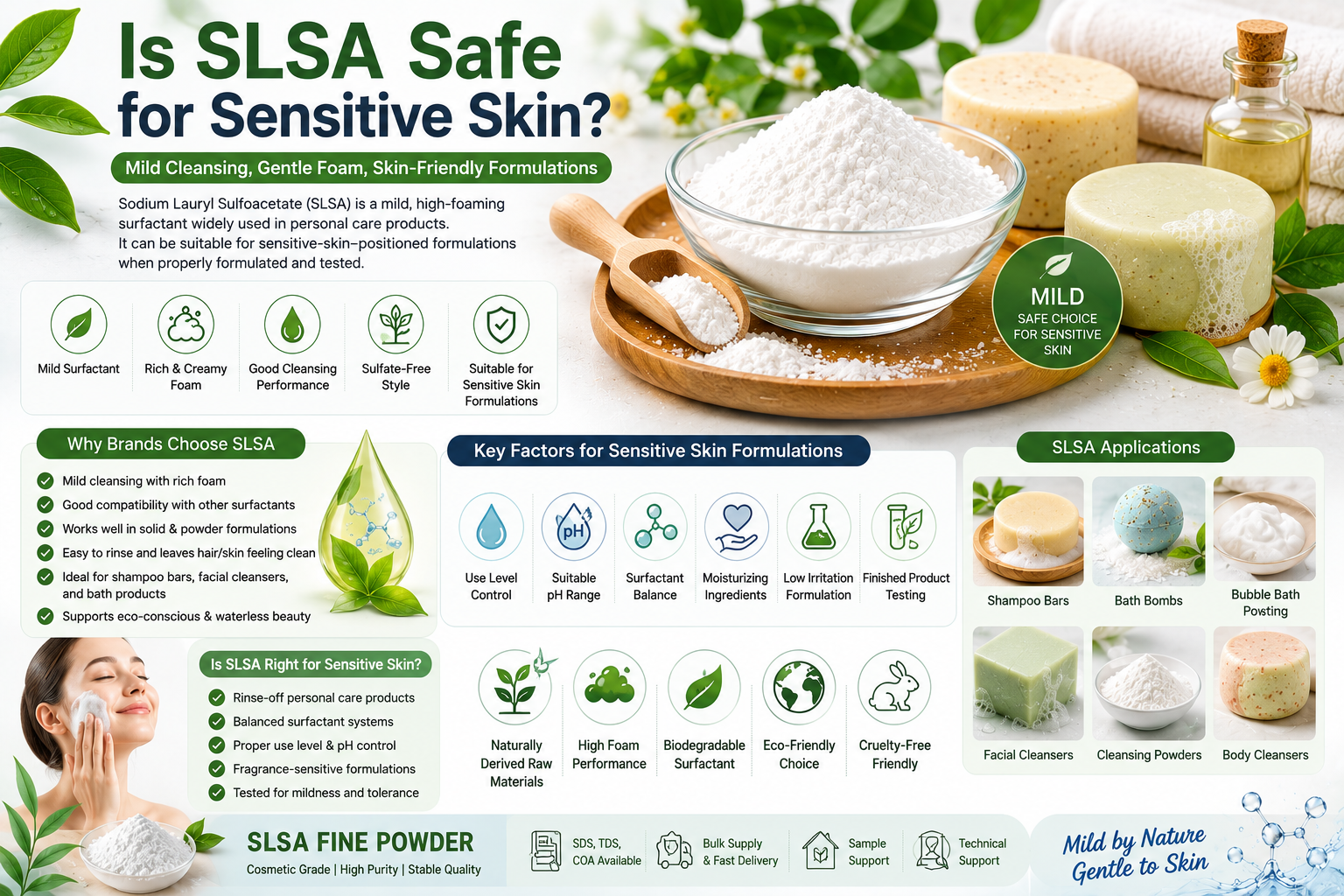
🌿 Which One is Milder?
👉 SCI is generally considered milder
But real mildness depends on:
- Full surfactant system
- Oil content
- pH
- Formulation design
- Finished product testing
👉 Key principle:
Mildness = formulation result, not single ingredient property
🚀 Industry Insight (Important for Brands)
Modern shampoo bar formulations rarely use only one surfactant.
Instead:
- SCI = structure + mildness
- SLSA = foam performance
- CAPB (optional) = foam stabilization
👉 This creates a high-performance solid cleansing system
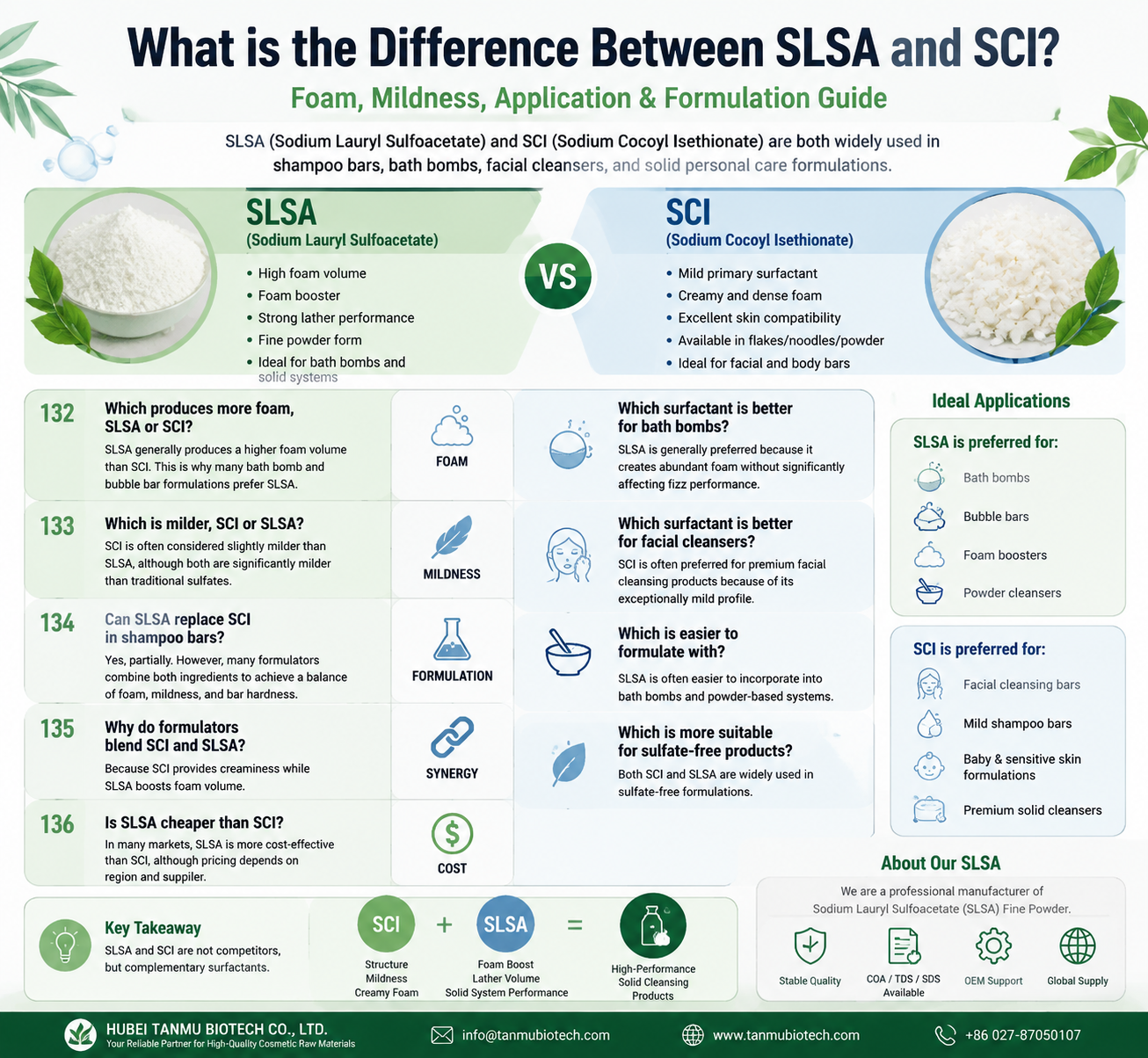
What is the difference between SLSA and SCI?
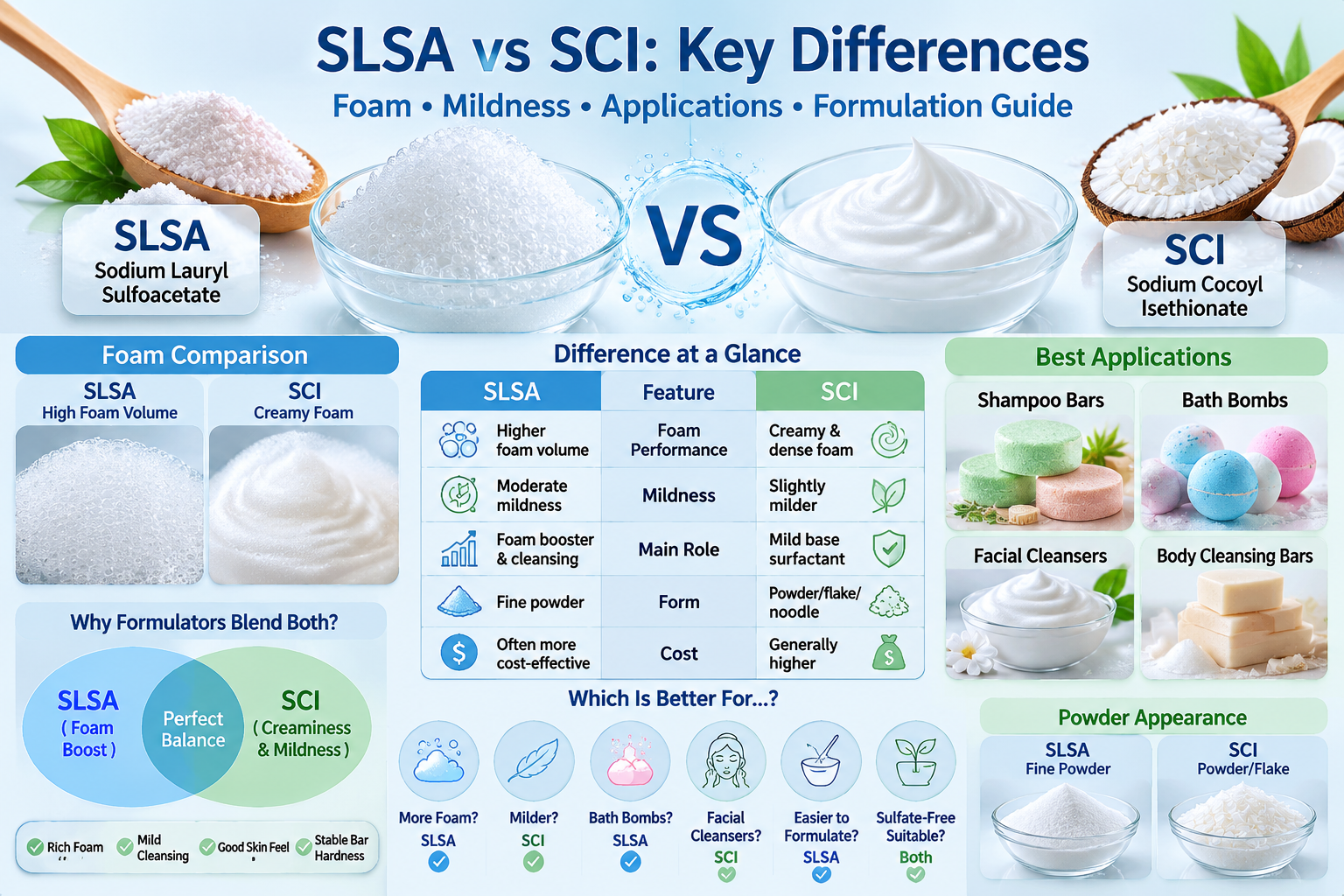
🫧 1. Which produces more foam, SLSA or SCI?
SLSA generally produces higher foam volume than SCI.
This is why many formulations such as:
- Bath bombs
- Bubble bars
- Foaming bath products
prefer SLSA as the main foam booster ingredient.
👉 Summary:
- SLSA = high foam volume
- SCI = creamy foam texture
🌿 2. Which is milder, SCI or SLSA?
SCI is often considered slightly milder than SLSA.
However, both are significantly milder than traditional sulfates such as SLS.
👉 Mildness ranking (general perception):
SCI > SLSA > traditional sulfates
But real mildness depends on:
- full formulation system
- pH value
- surfactant combination
- usage level
🧴 3. Can SLSA replace SCI in shampoo bars?
Yes, but only partially.
In modern shampoo bar formulations:
👉 Many formulators do NOT fully replace SCI with SLSA
Instead, they combine both to balance performance.
- SCI = base surfactant (structure + mildness)
- SLSA = foam booster (lather performance)
⚗️ 4. Why do formulators blend SCI and SLSA?
SCI and SLSA are often used together because they complement each other:
- SCI provides creamy foam & mild cleansing
- SLSA boosts foam volume & lather speed
👉 Result:
A shampoo bar with both:
- rich foam
- good mildness
- stable structure
💰 5. Is SLSA cheaper than SCI?
In many global markets:
👉 SLSA is often more cost-effective than SCI
However pricing depends on:
- region
- supplier
- purity grade
- production process
👉 Formulation insight:
Many brands use SLSA to optimize cost-performance balance in foam systems.
🛁 6. Which surfactant is better for bath bombs?
SLSA is generally preferred for bath bombs.
Because it:
- produces abundant foam
- works well in dry blending systems
- does not interfere with fizz reaction
👉 Bath bomb system logic:
- Citric acid + baking soda = fizz
- SLSA = foam enhancement
🧼 7. Which surfactant is better for facial cleansers?
SCI is often preferred for premium facial cleansers because:
- very mild profile
- creamy foam
- good skin compatibility
👉 SLSA can still be used, but usually in controlled formulations or powder-to-foam systems.
⚙️ 8. Which is easier to formulate with?
SLSA is often easier to use in:
- bath bombs
- powder cleansers
- dry blending systems
Because it is:
- fine powder
- easy to disperse
- compatible with solid systems
SCI may require more processing (flakes, noodles, melting system design).
🌿 9. Which is more suitable for sulfate-free products?
Both SLSA and SCI are widely used in sulfate-free formulations.
👉 Important clarification:
“Sulfate-free” does NOT mean surfactant-free.
It usually refers to replacing:
- SLS (Sodium Lauryl Sulfate)
- SLES (Sodium Laureth Sulfate)
with alternative surfactant systems like:
- SCI
- SLSA
- CAPB combinations
🏭 About SLSA Supply
We are a professional manufacturer of:
Sodium Lauryl Sulfoacetate (SLSA) Fine Powder
Suitable for:
- Shampoo bars
- Bath bombs
- Facial cleansers
- Cleansing powders
We provide:
- COA / TDS / SDS
- Stable bulk supply
- OEM support
- Sample testing
📩 Contact Us
🌿 Hubei Tanmu Biotech Co., Ltd.
📧 [email protected]
🌐 www.tanmubiotech.com
📞 +86 027-87050107



 Sales Manager
 Sales Manager