If you formulate solid shampoo bars, two ingredients appear again and again:
ラウリルスルホ酢酸ナトリウム (SLSA)
そして
ココイルイセチオン酸Na (科学者).
Both are anionic surfactants commonly used in solid cleansing products, and both can be used in syndet shampoo bars.
But they are not interchangeable ingredients.
Formulators frequently describe SCI as contributing a 密集, クリーミーな泡, while SLSA is often selected when a formula needs faster, more abundant bubbling and foam volume.
That distinction is also reflected in real-world formulator discussions.
In a long-running Soapmaking Forum discussion, an experienced syndet-bar maker summarized her working notes this way: SCI produced a mild, クリーミーな泡, while SLSA produced larger bubbles. She reported using roughly equal quantities of both in her own shampoo bar rather than choosing only one. [Source 1]
Another Soapmaking Forum shampoo-bar formula combined 28% SCI with 33% SLSA, describing SCI as the mild, creamy-foam component and SLSA as the component contributing additional bubbles. [Source 2]
These are practitioner observations, not controlled comparative studies.
しかし, they illustrate an important formulation principle:
The question is often not “SLSA or SCI?” but “what role should each surfactant play in this particular shampoo bar?」
簡単な回答: SLSA 対 SCI
| 財産 |
SLSA |
科学者 |
| INCI |
ラウリルスルホ酢酸ナトリウム |
ココイルイセチオン酸Na |
| Surfactant type |
アニオン性 |
アニオン性 |
| Typical physical form |
粉 / 粗粉 / flakes depending on grade |
粉 / 麺 / 顆粒 / flakes depending on grade |
| Foam profile commonly reported by formulators |
Faster, larger, more abundant bubbles |
Denser, creamier foam |
| Typical role in shampoo bars |
Primary or co-surfactant; foam booster |
Frequently used as a main solid surfactant |
| 処理 |
Powder can be readily incorporated into many solid systems |
Certain grades can require more processing to disperse or combine homogeneously |
| Useful when |
Foam volume and quick lather are important |
Creamy lather and a mild-focused surfactant system are priorities |
| Can they be combined? |
はい |
はい |
There is no universal winner.
The better choice depends on:
- desired foam profile
- 活性物質
- 加工方法
- target hair feel
- 棒の硬さ
- トータル界面活性剤システム
- コスト目標
- desired product positioning
In many formulas, SLSA and SCI are complementary rather than competing ingredients.
1. SLSAとは?
SLSA の略です:
ラウリルスルホ酢酸ナトリウム
It belongs to the sulfoacetate family of anionic surfactants.
One important distinction that formulators and consumers sometimes misunderstand is that:
Sodium Lauryl Sulfoacetate is not Sodium Lauryl Sulfate (SLS).
The names look similar, but they are different chemical materials.
Stepan, a major international surfactant producer, classifies its LATHANOL® LAL Sodium Lauryl Sulfoacetate as an anionic sulfoacetate surfactant and lists functions including foaming, wetting and emulsification. The company lists shampoo, soap bars, facial cleansers and other personal-care cleansers among its applications. [Source 3]
Stepan’s commercial LATHANOL LAL grade contains approximately 65% 活性物質 and is available in different physical forms. [Source 3]
Different commercial SLSA grades can have different active matter and physical characteristics, so formulators should always compare the supplier’s TDS and batch COA rather than assuming that all SLSA grades behave identically.
2. What Is SCI?
SCIはの略です:
ココイルイセチオン酸Na.
It is another anionic surfactant widely used in syndet bars and solid shampoo systems.
SCI is particularly well known among solid-bar formulators because it can form a substantial part of the surfactant base.
In a Chemists Corner technical discussion about SCI, formulators specifically noted that SCI is particularly suitable for solid syndet applications, while using significant levels in clear aqueous formulations can be more difficult because of its limited solubility and potential precipitation. [Source 4]
This is one reason SCI appears so frequently in:
- シャンプーバー
- クレンジングバー
- 洗顔バー
- other solid syndet systems
rather than only in transparent liquid shampoos.
3. The Biggest Practical Difference: 泡キャラクター
For shampoo-bar users, the most immediately noticeable difference is often foam.
Experienced shampoo-bar formulators repeatedly distinguish the two materials this way:
科学者
Often associated with:
密集, クリーミーな, finer lather
SLSA
Often associated with:
larger bubbles, quicker foam development and greater visible foam volume
A Soapmaking Forum contributor with extensive syndet-bar experience summarized her own formulation notes by saying that SCI produced a creamy foam while SLSA produced larger bubbles. She used approximately equal proportions of the two in her shampoo bar. [Source 1]
SwiftCraftyMonkey’s publicly available shampoo-bar formulation material makes a similar practical distinction. Its formulation guide describes SCI as producing creamy, elegant lather and describes SLSA as providing strong foaming, bubbling and lathering performance. [Source 5]
Stepan also identifies Sodium Lauryl Sulfoacetate as a foam booster and describes its LATHANOL LAL line as producing rich or creamy lather. [Source 3]
This does not mean SCI cannot generate good foam or that SLSA cannot produce creamy foam.
Foam behavior is determined by the complete surfactant system.
But when formulators are trying to tune foam character, changing the SCI:SLSA ratio is one practical variable worth investigating.
4. Why Many Formulators Use SCI and SLSA Together
There is a tendency in ingredient marketing to ask:
Which surfactant should replace the other?
Real formulation practice is often more nuanced.
A shampoo bar may benefit from combining different surfactants because each contributes different performance characteristics.
Soapmaking Forum contains multiple practical examples of formulas combining SCI and SLSA.
One basic syndet shampoo formula published by an experienced contributor used:
- 科学者: 28%
- SLSA: 33%
- コカミドプロピルベタイン: 26%
together with smaller amounts of structuring and conditioning materials. [Source 2]
Another forum discussion involved a formulator using around 40% SCIと 20% SLSA, with participants discussing how much solid versus liquid surfactant should be used and how particle form affected processing. [Source 6]
These are examples rather than recommended universal formulas.
The percentages should not simply be copied into a commercial formula.
But they demonstrate that combining SCI and SLSA is an established formulation approach among experienced solid-bar makers.
5. SCI Can Be an Excellent Structural Base for Shampoo Bars
One reason SCI is popular in solid shampoo bars is that formulators can use substantial quantities of it in the solid surfactant matrix.
In Soapmaking Forum discussions, users reported seeing or working with shampoo-bar formulas containing SCI around the 30–40% range. [Source 6]
Another discussion describes SCI as a key ingredient commonly used in syndet bars and recommends powdering or appropriately processing prilled material to improve incorporation. [Source 7]
This makes SCI especially useful when the formulator wants a substantial solid surfactant backbone.
しかし, the commercial grade matters.
SCI may be supplied as:
and those forms are not necessarily identical from a processing standpoint.
6. SCI Processing Can Be More Demanding
This is one area where formulators should pay close attention.
SCI is often discussed in formulation forums because some physical forms can be difficult to disperse or incorporate uniformly.
In Chemists Corner, professional formulators discussing SCI in liquid systems noted that SCI can be difficult to dissolve and may leave sediment if it is not properly processed. [Source 4]
Soapmaking Forum users similarly discuss:
- grinding SCI prills
- choosing powdered SCI
- blending SCI with liquid surfactants
- heating or melting depending on grade
One experienced contributor reported preferring powdered SCI because it produced a more consistent appearance and could be blended more homogeneously in the formulation. [Source 6]
Another reported grinding SCI prills because this made processing easier. [Source 7]
These observations should not be interpreted to mean that SCI is inherently difficult to manufacture with.
その代わり:
SCI processing depends strongly on the physical grade selected and the manufacturing process.
7. SLSA Can Be Useful When Fast Foam Development Is Important
SLSA is particularly interesting when visible lather and rapid foam generation are important sensory targets.
Stepan identifies Sodium Lauryl Sulfoacetate as a foam booster and supplies it for shampoo and soap-bar applications. [Source 3]
Experienced shampoo-bar formulators also commonly describe SLSA as contributing larger bubbles or more immediate bubbling compared with SCI. [Source 1]
This can be useful in products where consumers expect an obvious foam response immediately after rubbing the bar onto wet hair.
しかし:
more visible foam does not automatically mean better cleansing.
Foam perception and cleansing performance are related but not identical properties.
The entire surfactant system and active surfactant level must be considered.
8. Does SLSA Clean More Strongly Than SCI?
This question needs careful wording.
Formulation forums contain individual users who report that high levels of SLSA feel more cleansing or less comfortable for them personally.
例えば, in a Soapmaking Forum thread specifically titled “SLSA vs SCI,」 one contributor reported that she personally could not tolerate more than approximately 6% SLSA in her shampoo bars without scalp itching. [Source 8]
That is an individual user experience.
It does not establish that 6% is a safe maximum, recommended usage rate or universal irritation threshold.
Likewise, another Soapmaking Forum formula describes SCI as “mild” and SLSA as somewhat less mild in that formulator’s personal formulation notes. [Source 2]
These observations are useful because they show what formulators are experiencing in practice, but they should not be converted into claims such as:
“SCI is always mild and SLSA is harsh.”
That would be an oversimplification.
Final mildness depends on:
- 集中
- 総活性界面活性物質
- 界面活性剤配合
- amphoteric co-surfactants
- contact time
- finished-product pH
- deposition/conditioning system
- rinse behavior
- user sensitivity
Stepan itself markets its Sodium Lauryl Sulfoacetate grades as mild personal-care surfactants. [Source 3]
So the scientifically responsible conclusion is:
Do not determine formula mildness from the ingredient name alone. Evaluate the complete surfactant system and the finished product.
9. Do Not Compare SLSA and SCI Only by Raw-Material Percentage
This is particularly important for commercial formulation.
Suppose one ingredient is used at 30% and another at 40%.
That does not necessarily mean the 40% ingredient contributes more surfactant activity.
Commercial grades can differ significantly in active matter.
Always calculate:
Active Surfactant Matter
The basic calculation is:
Raw material percentage × active matter = active surfactant contribution
例えば:
If an SLSA grade is:
75% active
and it is used at:
20%
its approximate active surfactant contribution is:
20 × 0.75 = 15%
That calculation does not tell you whether the shampoo bar is good or bad.
But it gives a more meaningful basis for comparing formulations.
Formulators should therefore record:
- サプライヤー
- commercial grade
- 活性物質
- 投与量
- calculated ASM
rather than simply comparing the raw-material percentages.
10. Commercial SLSA Grades Are Not All Identical
This point becomes especially important when changing suppliers.
例えば, Stepan lists its LATHANOL LAL at approximately 65% 活性物質. [Source 3]
TANMU’s current published SLSA specification is ≥75% active matter.
したがって, changing between the two commercial grades should not automatically be treated as a kilogram-for-kilogram formula substitution.
If a formulator wants to maintain the same active surfactant contribution, the dosage calculation may need to change.
But as discussed in our separate shampoo-bar troubleshooting work, changing the raw-material dosage can also alter the physical matrix.
So both:
活性物質
そして
physical formulation structure
need to be considered.
11. Fine vs Coarse SLSA Also Matters During Manufacturing
SLSA can be supplied in different particle forms.
TANMU currently offers fine and coarse powder options, while Stepan also markets SLSA in multiple forms including powder and coarse grades.
Particle form may influence:
- dust generation
- powder handling
- mixing
- 濡れ
- distribution through the batch
- compression behavior
This does not mean coarse SLSA is automatically superior to fine SLSA or vice versa.
その代わり, select the particle form according to:
- factory equipment
- batch size
- operator handling requirements
- target appearance
- manufacturing process
For commercial producers, particle size should therefore be treated as a manufacturing parameter, not simply a cosmetic specification.
12. Dust Control Is an Important Practical Difference
Both SCI and SLSA can be supplied as fine powders.
Any fine surfactant powder should be handled with appropriate industrial hygiene controls according to the supplier’s SDS.
For production environments, this can make coarse, granular or lower-dust forms attractive where available.
This is especially relevant when moving from small laboratory batches to:
- 20 kg
- 50 kg
- 100 kg
- several-hundred-kilogram
production runs.
An ingredient that is convenient in a 500 g laboratory batch may behave differently operationally in a commercial mixer.
したがって, when evaluating SLSA vs SCI, procurement teams should not ask only:
“Which one produces better foam?」
They should also ask:
“Which commercial grade works best with our manufacturing process?」
13. What Professional Formulators Actually Discuss
Reviewing long-term formulation discussions reveals several recurring themes.
Theme 1 — SCI is frequently treated as a core shampoo-bar surfactant
Formulators regularly use SCI at substantial percentages in syndet bars. [Source 2, Source 6, Source 7]
Theme 2 — SLSA is often used to modify foam behavior
Experienced users frequently associate SLSA with larger bubbles or faster foam development. [Source 1]
Theme 3 — Combining them is common
Several practical formulas and discussions use both ingredients rather than treating them as exclusive alternatives. [Source 1, Source 2]
Theme 4 — Particle form matters
SCIパウダー, prills and other forms are repeatedly discussed because they affect processing. [Source 6, Source 7]
Theme 5 — The complete formula matters more than the surfactant name
Chemists Corner discussions repeatedly show that surfactant performance changes with:
- 共界面活性剤
- 油
- structural ingredients
- water
- pH
- 処理
- 製品フォーマット
rather than being determined by one ingredient in isolation.
14. SLSA vs SCI for Foam
If your main target is:
Fast, 目に見える泡
SLSA may be worth increasing or adding as part of the surfactant system.
If your target is:
密集, クリーミーな泡
SCI is frequently selected as an important part of the base.
If you want:
両方
A blend may be more useful than forcing one surfactant to provide every performance attribute.
This is one of the strongest practical lessons from experienced shampoo-bar formulators.
15. SLSA vs SCI for Processing
A very simplified practical comparison is:
SLSA
May be attractive when the process benefits from a readily dispersible powder surfactant and strong foaming contribution.
科学者
Can provide an excellent solid-bar base, but the processing route depends heavily on whether the material is supplied as:
and whether the formula is:
- 押された
- molded
- extruded
- heated
- cold processed
Chemists Corner has documented formulation discussions in which incomplete SCI incorporation resulted in sediment or poor homogeneity in aqueous systems. [Source 4]
Soapmaking Forum users similarly report different experiences with powdered versus granular or prilled SCI. [Source 6, Source 7]
したがって:
Always compare the exact commercial grade, not only the INCI name.
16. SLSA vs SCI for Bar Hardness
Neither ingredient alone determines shampoo-bar hardness.
A shampoo bar’s structure can also depend on:
- total powder content
- liquid surfactants
- water
- fatty alcohol
- stearic acid
- wax
- oils and butters
- humectants
- 処理温度
- compression
- drying
Chemists Corner has detailed examples where soft syndet bars were associated with broader matrix issues such as high fatty-material and hygroscopic loads rather than a single surfactant. [Source 9]
So statements such as:
“SCI always makes a harder bar.”
また
“SLSA always makes a softer bar.”
should be avoided unless supported by controlled testing of the specific formula.
17. SLSA 対 SCI: Which One Should a Formulator Choose?
A useful decision framework is:
Consider more SCI when you want:
- a solid surfactant backbone
- 密集, クリーミーな泡
- a formulation centered on a widely used syndet-bar surfactant
- a sensory profile where creamy foam is important
Consider SLSA when you want:
- faster visible lather
- larger bubbles
- additional foam volume
- a solid anionic co-surfactant
- another option for adjusting the shampoo-bar surfactant system
Consider combining SLSA + SCI when you want:
- both creamy and more abundant foam
- greater flexibility in foam design
- a multi-surfactant system rather than relying on one raw material
- the ability to tune performance by adjusting the ratio
The final ratio should be established experimentally.
There is no universal SLSA:SCI ratio suitable for every shampoo bar.
18. A Simple Laboratory Comparison
Instead of debating which surfactant is theoretically better, run a controlled comparison.
Prepare three small batches.
Formula A
SCI-dominant
Keep the remainder of the formula constant.
Formula B
SLSA-dominant
Keep total active surfactant matter as comparable as practical.
Formula C
科学者 + SLSA blend
Again, control total active surfactant matter.
Then evaluate:
| Test |
あ |
B |
C |
| Foam initiation |
|
|
|
| 泡の量 |
|
|
|
| クリーミーな泡立ち |
|
|
|
| Wet combing |
|
|
|
| Rinse feel |
|
|
|
| Bar hardness |
|
|
|
| Wet wear |
|
|
|
| Drying between use |
|
|
|
| Processing ease |
|
|
|
| Consumer preference |
|
|
|
This will give you much more useful information than comparing supplier marketing descriptions.
19. Why SLSA Can Be Especially Useful as a Co-Surfactant
From a formulation strategy perspective, one of SLSA’s most interesting roles is not necessarily replacing SCI entirely.
It can be used to change the behavior of an SCI-based system.
例えば, if an SCI-based shampoo bar gives acceptable hair feel and creamy foam but the formulator wants:
- quicker foam generation
- more visible bubbles
- a more dramatic lather experience
SLSA may be investigated as part of the co-surfactant system.
This reflects the practical approaches documented by experienced shampoo-bar formulators who use both materials in the same product. [Source 1, Source 2]
20. A Note About “Sulfate-Free”
SLSA’s name often causes confusion because it contains the word Lauryl, and because consumers may confuse it with Sodium Lauryl Sulfate.
化学的に, Sodium Lauryl Sulfoacetate belongs to the sulfoacetate surfactant group, while Sodium Lauryl Sulfate is an alkyl sulfate.
Stepan categorizes LATHANOL LAL as:
Chemical Group: Anionic Surfactants / Sulfoacetates
and markets it as sulfate-free. [Source 3]
SCI is an isethionate 界面活性剤.
This distinction is important when writing ingredient education or product marketing.
しかし, finished-product claims should always be checked against the complete formulation and applicable regulatory or retailer requirements.
21. What About Cost?
The answer depends on:
- commercial grade
- 活性物質
- quantity
- origin
- 梱包
- 貨物
- particle form
A direct comparison based only on:
USD/kg
can therefore be misleading.
A more useful commercial comparison is:
Cost per kilogram of active surfactant
例えば:
Raw-material price ÷ active fraction
This makes it easier to compare a:
65% active SLSA
with a:
75% active SLSA
or an SCI grade with a different active concentration.
Then factor in:
- processing cost
- production yield
- 防塵
- manufacturing time
- bar performance
Raw-material purchase price is only one part of the commercial decision.
22. TANMU SLSA for Shampoo-Bar Formulation
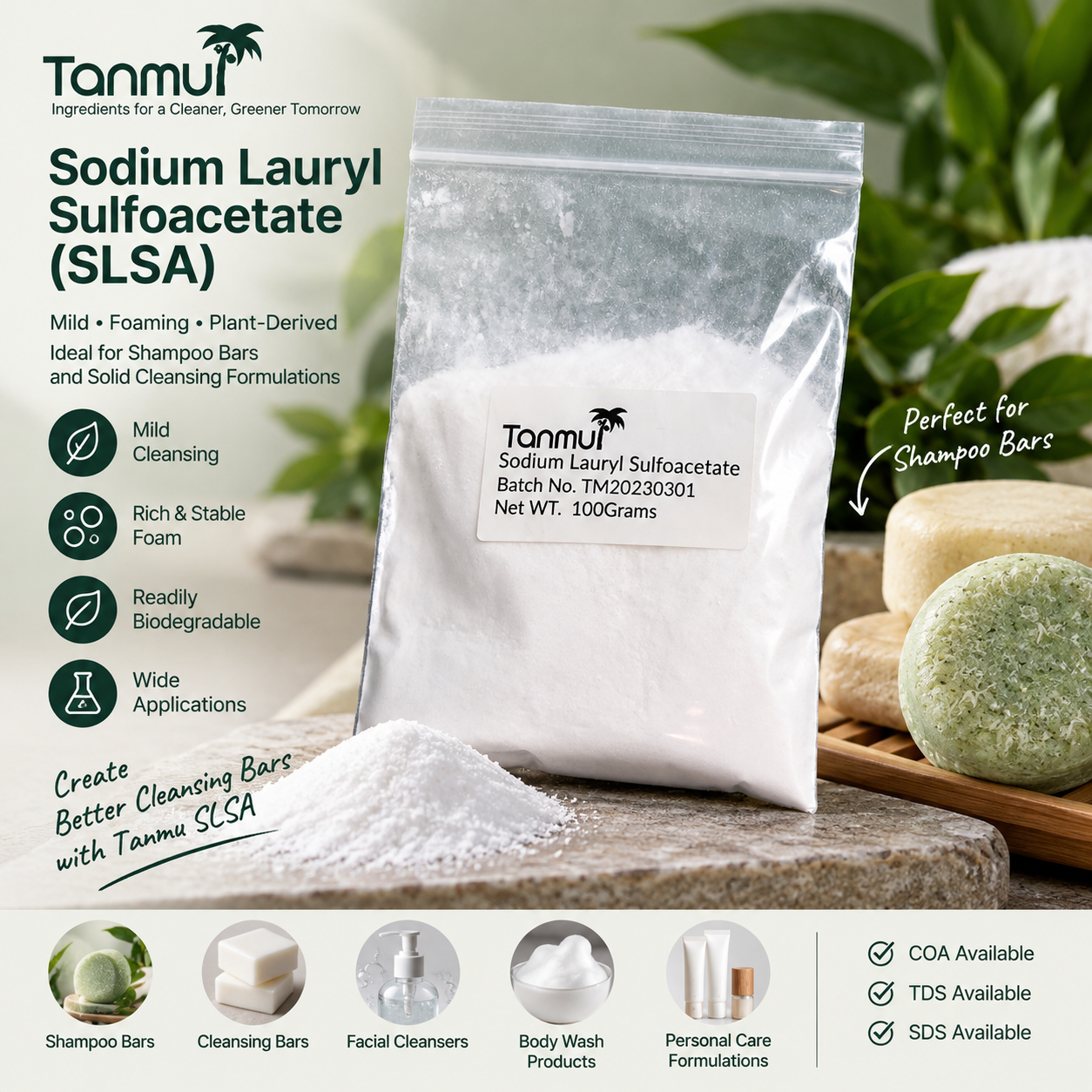
Hubei Tanmu Biotech manufactures and supplies ラウリルスルホ酢酸ナトリウム (SLSA) for personal-care applications including solid shampoo and cleansing formulations.
Current TANMU published SLSA information includes:
- INCI: ラウリルスルホ酢酸ナトリウム
- CAS番号: 1847-58-1
- 活性物質: ≥75%
- Available physical forms: Fine and coarse powder
- 標準パッキン: 25 kg/ドラム
- 技術文書: COA, TDSとSDSが利用可能
TANMU also supplies ココイルイセチオン酸Na (科学者), allowing formulators and manufacturers to evaluate both surfactants within the same broader solid-cleansing development program.
For manufacturers currently using a lower-active SLSA grade, TANMU recommends comparing:
- 活性物質
- 粒径
- finished-bar properties
- processing behavior
before making a full-scale substitution.
A laboratory trial should always precede commercial production.
よくある質問
Is SLSA better than SCI for shampoo bars?
There is no universal answer.
SCI is frequently used as a major solid surfactant and is commonly associated by formulators with dense, クリーミーな泡.
SLSA is frequently used where faster bubbling and higher visible foam are desirable.
Many formulators use them together. [Source 1, Source 2]
Can SLSA replace SCI 1:1?
Not automatically.
Compare:
- 活性物質
- particle form
- recommended usage
- 処理
- 総活性界面活性物質
- resulting bar structure
before making a substitution.
Can SCI and SLSA be used together?
はい.
This combination appears repeatedly in practical shampoo-bar formulations and formulation discussions. [Source 1, Source 2, Source 6]
The optimum ratio should be validated in the final formulation.
Which produces more bubbles?
Experienced formulators commonly report that SLSA contributes larger or more immediate bubbles while SCI produces denser, creamier foam. [Source 1, Source 5]
This is a useful formulation tendency rather than a guaranteed result for every formula.
どちらが穏やかですか?
Finished-product mildness cannot be reliably ranked from the ingredient names alone.
Some practitioner reports describe SCI as feeling milder in their formulas, while commercial SLSA suppliers such as Stepan also classify their SLSA grades as mild surfactants. [Source 2, Source 3]
Mildness should be assessed at the level of the complete formulation.
Why is SCI so common in shampoo bars?
SCI is highly suited to solid syndet applications and can form a substantial part of the solid surfactant matrix. Formulators also value its characteristic dense, クリーミーな泡. [Source 4, Source 5]
Why add SLSA to an SCI shampoo bar?
A formulator may use SLSA to modify foam character, particularly when faster lather formation or larger bubbles are desired.
This approach is documented in multiple practitioner formulations. [Source 1, Source 2]
SLSA は SLS と同じですか?
いいえ.
SLSA は ラウリルスルホ酢酸ナトリウム, a sulfoacetate surfactant.
SLSは ラウリル硫酸ナトリウム, an alkyl sulfate.
Stepan classifies Sodium Lauryl Sulfoacetate within the sulfoacetate chemical group. [Source 3]
最終的なポイント
The question:
“SLSA or SCI—which is better for shampoo bars?」
does not have a useful one-word answer.
A better way to think about the two ingredients is:
SCI can provide an excellent creamy-lather solid surfactant base, while SLSA can be used to increase or modify visible foam and bubbling characteristics.
多くの製剤では, the two ingredients can complement each other.
The most appropriate choice depends on:
- ターゲットフォームプロファイル
- active surfactant matter
- desired cleansing performance
- manufacturing process
- particle form
- 棒の硬さ
- hair feel
- コスト目標
For professional formulation work, compare the exact commercial grades and run controlled trials rather than assuming that all SLSA or SCI materials are identical.
References
Source 1 — Soapmaking Forum
Thread: ‘Squeaky’ Clean Syndet Shampoo Bars
Forum: Soapmaking Forum – Soap & Candle Forums
Discussion: 12月 2019
Relevant practitioner observations:
- SCI associated with creamy foam
- SLSA associated with larger bubbles
- experienced formulator using both in approximately equal proportions
- discussion of high active surfactant content in solid shampoo bars
Evidence classification: Practitioner/formulation-community experience, not controlled comparative research.
Source 2 — Soapmaking Forum
Thread: Syndet Shampoo Bar Recipe?
Forum: Soapmaking Forum – Soap & Candle Forums
Discussion: 2017
One practical syndet-bar example contained both SCI and SLSA, with the contributor characterizing SCI as contributing creamy foam and SLSA as contributing more bubbles.
Evidence classification: Practitioner formulation example; not a universal recommended formulation.
Source 3 — Stepan Company
製品: LATHANOL® LAL / LATHANOL LAL COARSE
INCI: ラウリルスルホ酢酸ナトリウム
Public technical information identifies the product as:
- 陰イオン界面活性剤
- sulfoacetate
- approximately 65% active
- foam booster
- suitable for shampoos and soap bars
- available in multiple physical forms
Stepan also describes the material as sulfate-free and readily biodegradable.
Evidence classification: Manufacturer technical/product information.
Source 4 — Chemists Corner Cosmetic Science Talk
Discussions:
ココイルイセチオン酸Na
Shampoo Batch Problems
Relevant professional discussion includes:
- SCI use in solid syndet applications
- SCI solubility limitations in some aqueous systems
- precipitation / incomplete incorporation
- processing SCI with other surfactants
Evidence classification: Professional cosmetic-formulation forum discussion.
Source 5 — SwiftCraftyMonkey
Resource: My Favourite Class Formulations – Hair Care Products
Section: Creating pH Balanced Shampoo Bars
The formulation notes describe:
- SCI as contributing creamy/elegant lather
- SLSA as contributing foaming, bubbling and lather
- use of both surfactants within shampoo-bar formulation
Evidence classification: Experienced cosmetic-formulation educator material.
Source 6 — Soapmaking Forum
Thread: Shampoo Bars – Surfactant Percentages
Discussion: 12月 2019
Relevant practitioner discussion includes:
- SCI/SLSA combinations
- SCI at substantial levels in syndet bars
- powdered vs granular SCI
- blending and processing
- influence of liquid surfactants on bar softness
Evidence classification: Practitioner formulation discussion.
Source 7 — Soapmaking Forum
Thread: SCI versus SLSA
Discussion: 六月 2017
Relevant topics include:
- use of SCI in syndet bars
- processing powdered versus prilled SCI
- grinding SCI to improve incorporation
- practical comparison of SCI and SLSA
Evidence classification: Practitioner discussion, not controlled comparison.
Source 8 — Soapmaking Forum
Thread: SLSA 対 SCI
Discussion: 4月 2021
The thread contains individual formulator experiences comparing SLSA and SCI, including personal scalp-response observations.
These personal responses should not be interpreted as scientifically established safe-use thresholds or universal irritation rankings.
Evidence classification: Individual practitioner/user experience.
Source 9 — Chemists Corner Cosmetic Science Talk
Thread: Shampoo Bar Too Soft/Crumbly
Discussion: 4月 2020
Professional participants discuss how shampoo-bar physical properties can be affected by:
- fatty-material loading
- hygroscopic ingredients
- surfactant choice
- particle form
- 処理
- overall matrix design
Evidence classification: Professional formulation-community discussion.
Source 10 — Hubei Tanmu Biotech Co., 株式会社.
Public TANMU information referenced in this article includes:
- SLSA and SCI product portfolio
- SLSA ≥75% active matter
- fine and coarse SLSA options
- SLSA use in shampoo-bar formulations
- availability of technical documentation
Commercial specifications should always be verified against the latest TANMU TDS and the relevant batch COA.
Technical Discussion & Reference Notice
This article is provided for technical discussion and formulation-development reference only.
The information above is based on publicly available manufacturer technical information, cosmetic-formulation educational material and industry-community discussions.
Comments from Soapmaking Forum, Chemists Corner and other formulation communities represent the experiences or opinions of individual contributors working with specific raw-material grades, formulations and processes. They are included to identify practical formulation considerations and should not be interpreted as controlled scientific evidence, universal formulation rules or finished-product safety conclusions.
The performance of SLSA and SCI may vary depending on:
- commercial grade
- 活性物質
- 粒径
- 共界面活性剤
- pH
- structural ingredients
- 水分含有量
- manufacturing process
- drying conditions
- final product format
Any shampoo-bar formulation or raw-material substitution should therefore be verified through appropriate laboratory trials, stability testing, safety assessment and finished-product evaluation before commercial production.
This article does not constitute a formulation guarantee, regulatory opinion or finished-product safety assessment.
Evaluating SLSA for Your Shampoo Bar?
湖北丹木生物技術用品 ラウリルスルホ酢酸ナトリウム (SLSA) for solid shampoo, cleansing bars and other personal-care formulations.
活性物質: ≥75%
利用可能なフォーム: 微粉 / 粗粉
標準梱包: 25 kg/ドラム
書類: COA, TDSとSDSが利用可能
TANMU also supplies ココイルイセチオン酸Na (科学者) for formulators developing SCI/SLSA surfactant systems.
For formulation trials, technical specifications, samples or bulk supply inquiries, contact TANMU for the current TDS and batch-specific documentation.



 営業部長
営業部長
 営業部長
営業部長